Moving Indoors for Winter Quietly Removes Most of Your Bone Loading
Quick Answer: Bone responds to high-magnitude, rapid, varied loading — not to volume. Losing outdoor walking costs you less than you’d think, but losing the varied terrain, the stairs, the carrying, and the occasional fast movement costs a lot. Replace it with two short weekly sessions of impact and resistance work: hopping or jumping variations, weighted step-ups and carries, and progressive strength work. Ten to fifteen minutes twice a week is enough to matter.
Every autumn the total amount of walking people do drops sharply. The usual concern is cardiovascular fitness or weight.
The less-discussed loss is bone stimulus — and unlike fitness, bone changes are slow to build and slow to notice, which means the cost of a quiet winter shows up years later.
What actually stimulates bone?
Not what most people assume, and the difference matters for how you replace it.
Bone adapts to mechanical loading, and the research points consistently at three qualities:
Magnitude. Higher forces produce more stimulus. This is why resistance training and impact work do more than walking, and why heavier is generally better than lighter.
Rate. How fast the load is applied matters, possibly more than the peak force. A rapid, dynamic load — a hop, a jump, a fast step — stimulates bone more than the same force applied slowly. This is why jumping outperforms slow heavy lifting for some bone outcomes.
Novelty and variation. Bone responds to unusual loading patterns and habituates quickly to repeated identical ones. A bone that experiences the same load ten thousand times stops responding. This is the single most important and least-known principle, and it’s why walking the same flat route daily provides very little ongoing bone stimulus.
And one more finding that shapes the whole approach: the response saturates quickly. A small number of loading cycles captures most of the available benefit, and additional repetitions add very little. Studies suggest something in the range of 40 to 100 impacts gets you most of what’s available in a session.
Which is genuinely good news: an effective bone session is short.
What exactly do you lose when you move indoors?
Not the step count, mostly. The variation.
Summer walking outdoors involves uneven ground, kerbs, slopes, grass, gravel, stairs, and unpredictable direction changes. Every one of those is a novel loading pattern from a slightly different angle. Bone loves that.
Indoor life is flat, even, predictable, and cushioned. A treadmill walk and a park walk are very different things from a bone perspective, even at identical duration.
You also lose:
- Carrying. Groceries from further away, garden work, moving things around outside. Loaded carries are excellent bone stimulus and they disappear.
- Stairs. Outdoor stairs, kerbs, entrance steps. Stair descent in particular produces high-rate loading.
- Occasional fast movements. Jogging for a crossing, catching yourself on uneven ground, moving quickly. Small, rare, and disproportionately valuable.
- Total impact volume. Even ordinary walking on hard ground provides more impact than moving around a carpeted house.
The number that surprises people: the drop in daily steps from summer to winter is commonly 2,000 to 4,000, and the drop in varied loading is proportionally much larger than that.
What replaces it, specifically?
Two short sessions a week, and they can be done at home.
Session type A — Impact (about 8 minutes):
- Hops or jumps: 4 sets of 10, with about 30 seconds between sets. Two-footed jumps, hopping in place, or jumping and landing softly. The rest between sets matters — bone cells desensitize within a set and resensitize during rest, so short sets with rest beats one long set.
- Vary the direction. Some sets forward and back, some side to side, some with a quarter turn. Novelty is the principle.
- Stair descent, if you have stairs. Walking down stairs briskly is high-rate loading and it’s free.
Session type B — Resistance (about 15 minutes):
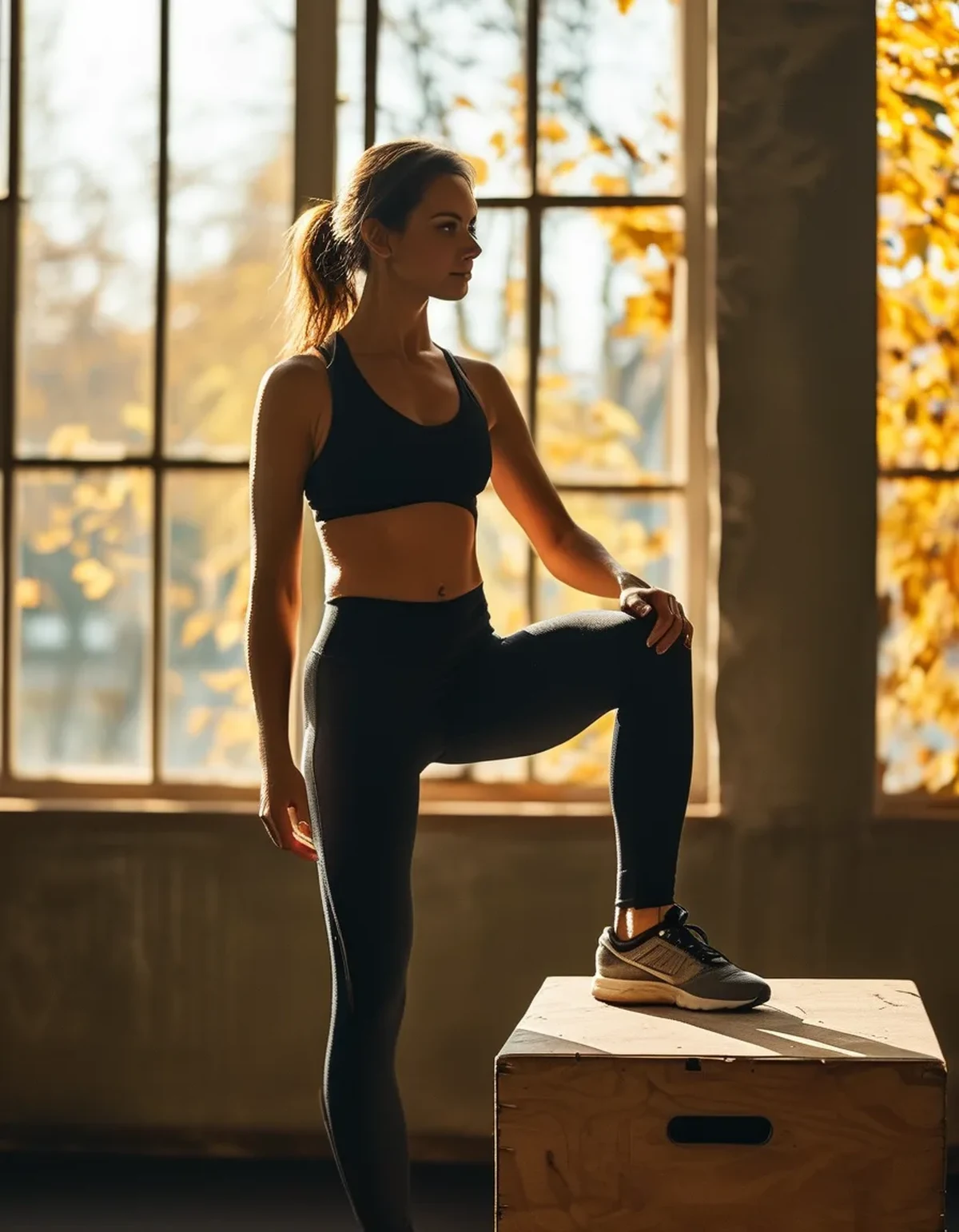
- Weighted step-ups, 3 sets of 8 per side, holding whatever weight you have.
- Loaded carries — a heavy bag in each hand, walk 30 seconds, 3 rounds. Excellent for spine and hip loading.
- Squats or sit-to-stands with load, 3 sets of 8 to 10.
- A hinge movement — deadlift variation, hip hinge with weight — 3 sets of 8.
The key on resistance work: it has to be genuinely challenging. Bone responds to magnitude, and light weights for high reps do relatively little. Progressive loading is the mechanism.
Frequency: two sessions a week of each type, or alternate them across four short sessions. More is not much better — the response saturates.
Myth vs Fact: Bone and Exercise
Myth: Walking is good for your bones. Fact: Walking is excellent for many things and modest for bone. Studies of walking programs in postmenopausal women generally show small or no effects on bone density, because walking doesn’t provide enough magnitude or rate. It’s not useless — it’s just not the tool for this specific job.
Myth: Swimming and cycling build bone. Fact: They’re outstanding exercise and they’re non-weight-bearing, which means minimal bone stimulus. Athletes in these sports sometimes have lower bone density than expected. If cycling or swimming is your main activity, bone work has to be added separately — this is important and often missed.
Myth: More exercise is better for bone. Fact: The response saturates quickly. Forty to a hundred impacts captures most of what’s available. Two hundred jumps is not twice as good as a hundred, and the extra fatigue costs you elsewhere.
Myth: It’s too late if you’re past menopause. Fact: Resistance and impact training produce measurable benefits at every age studied, including in people with established osteoporosis — with appropriate modification. The exercise changes; the principle doesn’t.
Myth: Calcium supplements are the main intervention. Fact: Adequate calcium and vitamin D are necessary and not sufficient — they’re raw materials, and loading is the signal that tells the body to use them. The second myth here is the one that catches the most people, because a dedicated cyclist or swimmer often assumes they’re covered.
If you have diagnosed osteoporosis, a history of fracture, or spinal conditions, get a program from a professional before starting impact work — some movements, particularly loaded spinal flexion, are contraindicated. This is general information, not medical advice.
How do you actually fit this into autumn?
The practical version, designed to survive.
Attach it to something existing. The impact session takes eight minutes and needs no equipment. Do it after an existing workout, or in the kitchen while something cooks. The barrier is remembering, not time.
Keep the stairs. If you have stairs at home or work, use them deliberately — up and down, a few times, briskly. This is the closest free replacement for what outdoor walking provided.
Carry things. Groceries in from the car in one trip with heavy bags rather than three light trips. Genuinely counts.
Preserve some outdoor walking on varied ground, even reduced. A weekend walk on a trail or uneven ground provides loading variety that no indoor session replicates. Once a week is worth protecting.
Don’t forget vitamin D. Sun exposure drops sharply from October, and vitamin D status affects calcium absorption. Worth discussing with a doctor, particularly at higher latitudes.
Track it simply. Two marks on a calendar per week. Bone changes take six to twelve months to show on a scan, which means there’s no short-term feedback at all — and that’s exactly why it needs to be scheduled rather than felt.
Start now, not in January. Not because of urgency, but because a habit established in September while the weather is still mild is one that exists when the weather is genuinely bad. This is the specific kind of training where the payoff is invisible for a year and the cost of skipping a winter is also invisible — which makes the structure the entire game.
TL;DR:
- Bone responds to magnitude, rate, and novelty — not to volume. The response saturates at 40–100 impacts.
- Moving indoors costs you varied loading more than steps: uneven ground, kerbs, stairs, carrying, occasional fast movement.
- Replace it with two short sessions a week: hops in 4 sets of 10 with rest between, plus weighted step-ups, carries, squats, and hinges.
- Walking is modest for bone. Swimming and cycling are non-weight-bearing — add loading separately.
- Protect one weekly outdoor walk on varied ground, use stairs deliberately, and check vitamin D.
There’s no short-term feedback here — bone changes take six to twelve months to measure. That’s exactly why it has to be on a schedule. This is general information, not medical advice.
Keep Reading
This article is for general informational purposes only and is not medical advice. Always consult a qualified health professional for guidance specific to you.