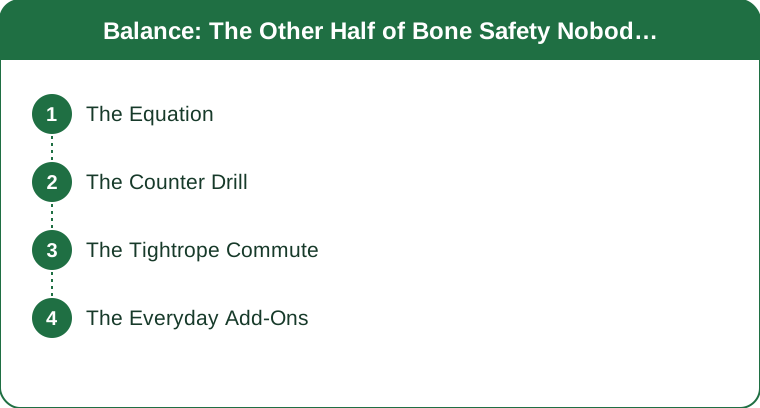
Balance: The Other Half of Bone Safety Nobody Trains
Quick Answer: Bone fractures require both a fragile bone and an impact, so training your balance to reduce falls cuts risk just as effectively as building bone strength — and balance improves faster, often within weeks of a simple daily routine like one-leg stands and heel-to-toe walking.
You’ve heard the calcium talk. You’ve maybe even started the squats. But there’s a second half of the fracture equation that almost nobody trains on purpose.
It starts at the kitchen counter, takes three minutes, and it’s arguably the faster win of the two.

Why does balance matter as much as bone strength?
A fracture needs two things to happen together: a bone fragile enough to break, and an impact hard enough to break it. Reduce your fall risk and you’ve cut the whole equation in half, regardless of how strong or fragile your bones currently are.
Most people put all their effort into the bone-strength side — calcium, vitamin D, weight-bearing exercise like squats. That’s genuinely worthwhile. But the fall side of the equation is trainable too, and it tends to respond faster than bone density does.
- Bone strength builds gradually over months of consistent loading and nutrition.
- Balance is a skill your nervous system can noticeably improve within weeks of regular practice.
- Together, they attack both variables in the fracture equation instead of just one.
Ignoring balance training is like reinforcing only one leg of a two-legged stool.
What’s a simple daily balance drill you can actually stick with?
The classic entry point is the one-leg counter stand: balance on one leg for 30 seconds a side while the kettle boils, fingertips hovering just above the counter as a safety net rather than a crutch. It’s short enough to fit into a task you’re already doing, which is exactly why it’s sustainable.
Once it starts to feel easy, add a small challenge:
- Close one eye to remove some visual feedback.
- Turn your head slowly side to side while balancing.
- Try it on a slightly softer surface, like a folded towel.
Each small addition asks your balance system to work a little harder, which is exactly what keeps the improvements coming instead of plateauing.
How does heel-to-toe walking help prevent falls?
Heel-to-toe walking down a hallway — placing one foot directly in front of the other, ten steps, arms out for balance if you need them — trains the exact wobble-recovery reflex your ankles rely on every time you step off a curb or misjudge a stair.
It looks a little silly, and that’s fine — imaginary circus applause is entirely optional but encouraged. What matters is that it’s rehearsing a genuinely useful skill: catching a small stumble before it becomes a fall.

A few real-world moments where this reflex gets tested: stepping off an uneven curb, catching a toe on a rug edge, or shifting your weight suddenly on a crowded sidewalk. Training it deliberately means your body already knows the move when it happens for real.
Can you fit balance training into chores you already do?
Yes, and honestly this is the most sustainable version of a balance habit. Balance hides happily inside ordinary chores — standing on one leg while brushing your teeth, shifting your weight side to side while doing dishes, or trying a few minutes of tai chi if you like the more elegant version.
A few easy places to slot it in:
- Brushing teeth — stand on one leg for the full two minutes.
- Washing dishes — gently shift weight from foot to foot.
- Waiting for the microwave or toaster — a quick one-leg stand.
- Folding laundry — alternate standing on one leg between items.
Three scattered minutes across a day, tucked into things you’re already doing, is genuinely the entire prescription. No special equipment, no gym membership, no dedicated block of time required.
5 Mistakes Everyone Makes With Balance Training
- Only training bone strength and skipping balance entirely. Bone density is half the equation — falls are the other half, and they’re often faster to improve.
- Practicing without any safety net nearby. Fingertips near a counter or wall aren’t cheating; they’re what let you push the difficulty safely.
- Doing balance work once and expecting lasting results. Like any skill, balance needs regular, short repetition — a few scattered minutes daily beats one long session weekly.
- Ignoring footwear during practice. Loose slippers or worn-out shoe soles undermine balance work that’s otherwise done correctly.
- Assuming balance training is only for older adults. Balance can decline at any age with a sedentary lifestyle, and it’s just as trainable at any age too.
FAQ: Balance Training for Bone Safety
How quickly does balance training actually improve?
Many people notice measurable improvement within a few weeks of consistent daily practice, since balance is largely a trainable nervous-system skill rather than something fixed. That’s notably faster than the months it typically takes to build bone density.
Is it safe to do balance exercises without supervision?
For basic drills like one-leg stands and heel-to-toe walking, most people can practice safely near a counter or wall for support. If you have a history of falls, dizziness, or a balance-affecting condition, it’s worth checking with a doctor or physical therapist before starting, so they can tailor the drills to you.
Do I need special equipment for balance training?
No — a kitchen counter, a hallway, and a few spare minutes are enough for the core drills. Optional additions like a foam pad or closing your eyes can increase difficulty later, but they’re not required to get started.
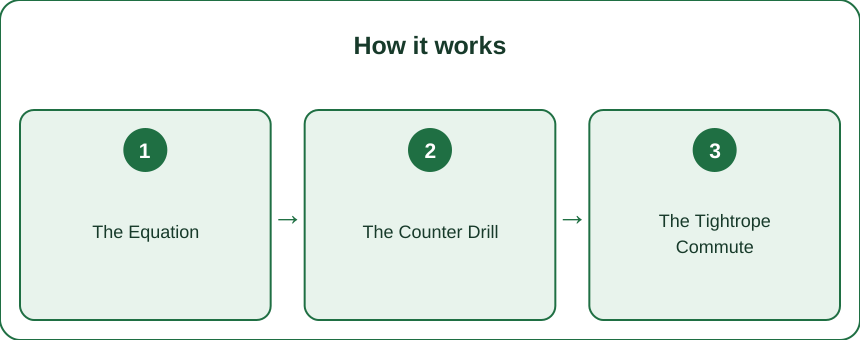
TL;DR:
- A fracture requires both a fragile bone and a fall — reducing fall risk cuts the equation in half.
- Balance often improves faster than bone density, sometimes within weeks of regular practice.
- One-leg counter stands and heel-to-toe hallway walks are simple, equipment-free starting drills.
- Balance training fits naturally into daily chores like brushing teeth or doing dishes.
- Check with a doctor or physical therapist first if you have a history of falls or dizziness.
Keep Reading
This article is for general informational purposes only and is not medical advice. Always consult a qualified health professional for guidance specific to you.