The Complete Guide to Building Bone Density in Your 40s, From Someone Starting at Zero
Quick Answer: Building bone density starting in your 40s requires progressive weight-bearing and resistance training (not cardio alone), adequate calcium and vitamin D intake, and realistic expectations — meaningful bone density change takes 6-12 months of consistent training to show up on a scan, even though strength and confidence improve much sooner. Starting from zero is a completely normal and workable starting point, not a disadvantage.
Bone density conversations often assume you already have a training background, which leaves genuine beginners without a real starting point. This is that starting point, from the actual beginning.

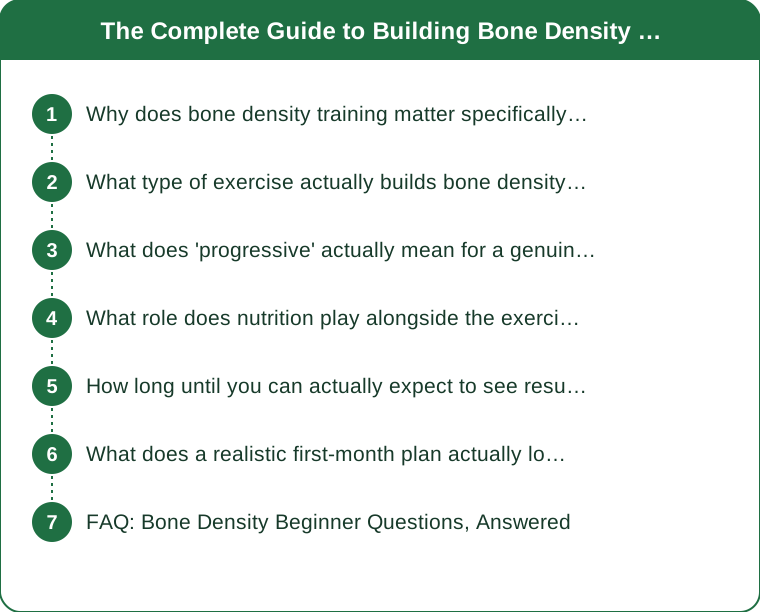
Why does bone density training matter specifically starting in your 40s?
Bone density naturally begins a gradual decline starting around the mid-30s to 40s for most people, and this decline can accelerate significantly around perimenopause and menopause due to hormonal changes, particularly the drop in estrogen, which plays a direct role in bone maintenance.
Starting resistance training in your 40s isn’t early or unnecessary — it’s arguably the ideal window, since building strength and bone-loading habits before the more accelerated decline phase gives your body a stronger baseline to work from. Waiting until noticeable bone loss has already occurred means starting from a more reactive position rather than a proactive one.
The encouraging part: bone tissue responds to mechanical loading throughout life, not just in youth — this is why weight-bearing exercise remains one of the most evidence-supported interventions at any starting age, including genuinely starting from zero training experience.
What type of exercise actually builds bone density, and what doesn’t?
Weight-bearing and resistance exercise are the categories with the strongest evidence for bone density benefit — this includes bodyweight training, resistance band work, free weights, and any activity where your bones bear load against gravity or resistance.
Pure cardio like swimming or cycling, while excellent for cardiovascular health, provides comparatively less bone-loading stimulus, since the body’s weight isn’t being borne against gravity in the same way, and there’s minimal resistance for bones to adapt to. This doesn’t mean cardio should be dropped — it means resistance and weight-bearing work needs to be added specifically for the bone density goal, not substituted with cardio alone.
Walking counts as weight-bearing exercise and is a genuinely valuable baseline activity, but for meaningful bone density improvement beyond baseline maintenance, progressive resistance training (increasing weight or resistance over time) tends to show stronger results in research than walking alone.
What does ‘progressive’ actually mean for a genuine beginner?
Progressive simply means gradually increasing the demand on your bones and muscles over time — this could mean slightly heavier weights, more repetitions, or more challenging variations of an exercise as the current level starts to feel manageable, roughly every few weeks depending on how quickly you’re adapting.
For a true beginner, this starts extremely modestly: bodyweight squats, wall push-ups, and light resistance band work are entirely legitimate starting points, not something to rush past. The mistake many beginners make is either starting too aggressively (risking injury and burnout) or staying at the exact same easy level indefinitely (missing the progressive stimulus that actually drives adaptation).
A reasonable beginner framework: start with bodyweight and light resistance for the first 4-6 weeks, focusing entirely on learning correct form, then begin gradually adding load or difficulty once movements feel controlled and comfortable rather than effortful in a shaky, uncertain way.

What role does nutrition play alongside the exercise itself?
Adequate calcium and vitamin D intake are the two nutrients most directly tied to bone health, and many adults, especially those with limited sun exposure or dairy intake, run genuinely low on one or both without realizing it.
Calcium needs for most adult women are around 1,000-1,200mg daily, achievable through diet (dairy, leafy greens, fortified foods) for many people, though supplementation is sometimes recommended if dietary intake consistently falls short — this is worth discussing with a doctor rather than guessing.
Vitamin D, unlike calcium, is harder to get sufficiently from diet alone for most people and often requires either meaningful sun exposure or supplementation, particularly in northern climates or for anyone who spends most of the day indoors. Low vitamin D specifically impairs the body’s ability to actually absorb and use dietary calcium, making it a genuinely foundational piece rather than an optional add-on.
Protein intake also matters more than most bone-density advice mentions — adequate protein supports the muscle mass that itself contributes to bone loading and fall-prevention strength, making it part of the same overall picture rather than a separate goal.
How long until you can actually expect to see results?
This is the part that trips up most beginners: strength and confidence improvements typically show up within 4-8 weeks, well before any actual bone density change would be measurable on a scan. This early strength gain is real and valuable, but it’s not the same thing as measurable bone density change yet.
Actual bone density change, if it’s going to happen, typically takes 6-12 months of consistent training to become detectable on a DEXA scan (the standard bone density measurement), and for some people, the realistic goal is slowing further loss rather than dramatically increasing density, particularly for anyone starting after menopause has already been established for some time.
This extended timeline is exactly why consistency matters more than intensity for a genuine beginner. A moderate, sustainable routine followed consistently for a year produces better results than an aggressive routine that leads to burnout, injury, or quitting after two months. Setting the expectation correctly from the start — that this is a months-long, not weeks-long, process — prevents the discouragement that causes many beginners to quit right before results would have become visible.
What does a realistic first-month plan actually look like?
A genuinely sustainable starting plan for someone with zero training background: 2-3 resistance training sessions per week (bodyweight and light resistance to start), each roughly 20-30 minutes, focused on major movement patterns — squats, presses, rows, and simple balance work.
Pair this with daily walking as a baseline weight-bearing activity, and don’t feel pressure to add more volume or intensity in the first month specifically — the priority in month one is building the consistency habit and learning correct form, not maximizing training stimulus.
Track how you feel, not just what the scale or a scan says — improved balance, less fatigue climbing stairs, and increased confidence with everyday movement are all genuine early signals the training is working, even before any bone-density-specific measurement would show change.
From here, the plan for months two through six is simply progressive addition — slightly more resistance, slightly more challenging variations, added consistently — rather than a dramatically different approach. Bone density training, especially for a true beginner, rewards patience and consistency far more than intensity.
FAQ: Bone Density Beginner Questions, Answered
Is it too late to start building bone density in my 40s or 50s?
No — bone tissue remains responsive to mechanical loading throughout adulthood, and starting resistance training in your 40s or 50s still provides meaningful benefit, even if the rate of improvement differs from someone starting in their 20s.
Do I need a personal trainer to start safely?
Not necessarily, though a few sessions with a qualified trainer to learn correct form on key movements (squats, presses, rows) can meaningfully reduce injury risk for a genuine beginner, especially with no prior training background.
How do I know if my bone density is actually a concern, or if I’m being overly cautious?
A DEXA scan, typically recommended starting around menopause or earlier with specific risk factors, is the only way to know your actual bone density status — this is worth discussing directly with your doctor rather than assuming based on age alone. This is general information, not medical advice.
TL;DR:
- Bone density decline often accelerates around perimenopause, making 40s a genuinely good starting window
- Weight-bearing and resistance training have stronger bone-density evidence than cardio alone
- Progressive doesn’t mean aggressive — start with bodyweight and build gradually
- Calcium, vitamin D, and protein all support the training’s effectiveness
- Real bone density change takes 6-12 months — strength gains show up much sooner
This is general information, not medical advice — a DEXA scan and a conversation with your doctor are the actual way to know where you’re starting from.
Keep Reading
This article is for general informational purposes only and is not medical advice. Always consult a qualified health professional for guidance specific to you.