The Perimenopause Bone Density Playbook: A Complete Strength Training Plan
Quick Answer: Bone density loss can begin accelerating during perimenopause, often years before a final period, which means a bone-protective strength plan needs to start in your 40s, not wait until an official menopause diagnosis or a low bone scan result.
Most bone health advice targets postmenopausal women, as if the whole issue starts on a single dramatic day. In reality, the estrogen decline driving bone loss starts gradually, during perimenopause — a window that can last several years and is exactly when a targeted strength plan does the most good.

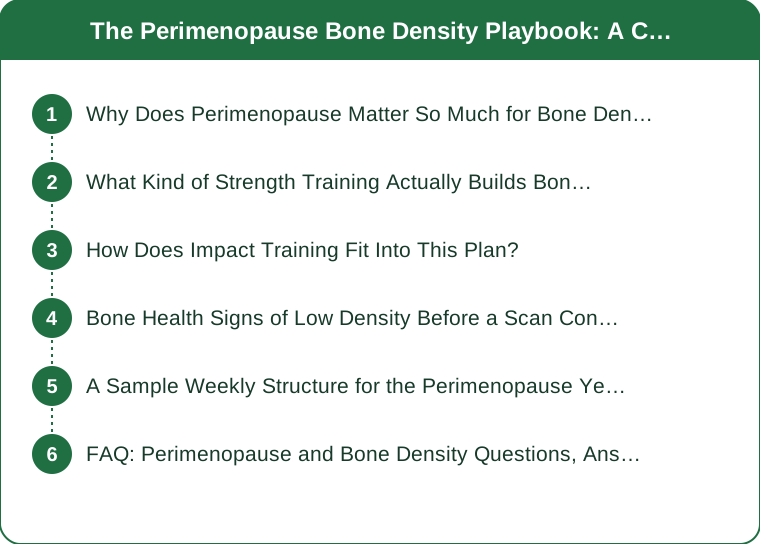
Why Does Perimenopause Matter So Much for Bone Density?
Estrogen plays a direct role in maintaining bone remodeling balance, and as levels start fluctuating and declining during perimenopause — which can begin in your late 30s to mid-40s — the rate of bone breakdown can start outpacing new bone formation years before menopause is officially diagnosed.
This means the “prevention window” most people associate with post-menopause has actually already been open for a while by the time many women start paying attention to bone health. Waiting for a bone scan to show a problem means missing years where strength training could have made the biggest difference.
The encouraging counterpoint: bone tissue responds to mechanical loading throughout life, including during and after this transition. It’s a later start than ideal, not a missed window entirely.
What Kind of Strength Training Actually Builds Bone Density?
Bone responds specifically to load that’s higher than what it normally experiences — this is why walking, while great for cardiovascular health, does very little for bone density on its own. Progressive resistance training with real, challenging loads is what triggers the adaptive response.
Compound, weight-bearing lifts — squats, deadlifts, overhead presses, and loaded carries — hit the hip and spine, the two sites where fracture risk matters most as bone density declines. Machine-based leg presses and lighter isolation work have a place but shouldn’t replace these bigger lifts.
A practical structure: 3 sessions per week, each built around 1-2 compound lifts done for 3 sets of 6-8 reps at a weight that feels genuinely challenging by the last two reps, plus 15-20 minutes of accessory work.
How Does Impact Training Fit Into This Plan?
Impact — jumping, hopping, or any activity involving brief ground-reaction force well above bodyweight — provides a different bone-loading stimulus than lifting alone, and research on perimenopausal and postmenopausal women shows measurable benefit from adding it a few times a week.
This doesn’t need to mean box jumps if that feels intimidating. Simple options like jump rope for 5-10 minutes, stair sprints, or even structured hopping drills 2-3 times a week provide meaningful impact loading at a manageable intensity.
Anyone with existing joint issues, a prior fracture, or a known low bone density diagnosis should get clearance from a doctor or physical therapist before adding impact work — this is general information, not medical advice tailored to your specific bone health status.

Bone Health Signs of Low Density Before a Scan Confirms It
A DEXA scan is the only reliable way to actually measure bone density — no symptom reliably predicts it beforehand. That said, some indirect signals are worth paying attention to: a family history of osteoporosis, an early menopause transition, a history of eating disorders or prolonged low-calorie dieting, or long-term use of certain medications like corticosteroids.
If several of these apply to you, it’s worth asking a doctor about a baseline DEXA scan in your 40s rather than waiting for the standard screening age, since a baseline measurement gives you something concrete to track against as you age.
Nutrition matters alongside training: adequate protein intake (roughly 1.2-1.6g per kg of bodyweight for active adults), calcium from food sources, and vitamin D status all support the structural work strength training is doing.
A Sample Weekly Structure for the Perimenopause Years
Monday: Squat or leg press focus — 3 sets of 6-8 reps, plus lunges and core work. Wednesday: Deadlift or hip hinge focus — 3 sets of 6-8 reps, plus loaded carries. Friday: Overhead press and upper body focus, plus 10 minutes of jump rope or stair sprints for impact loading.
Rest at least one full day between the heavy lower-body sessions to allow adequate recovery, and reassess loads every 3-4 weeks — bone and strength adaptations both require progressive overload over time, not a single heavy week.
FAQ: Perimenopause and Bone Density Questions, Answered
At what age should I start thinking about bone density specifically?
Most experts suggest paying attention starting in your late 30s to early 40s, since perimenopausal bone loss can begin well before an official menopause diagnosis.
Is walking enough to protect bone density during perimenopause?
Walking supports general health but doesn’t provide enough mechanical load on its own — progressive resistance training and some impact work are what drive bone-specific adaptation.
Do I need a DEXA scan before starting a bone-focused strength program?
Not necessarily to start training, but if you have risk factors like family history or early menopause, ask a doctor about a baseline scan so you have something to track over time.
Can strength training reverse bone loss that’s already happened?
It can meaningfully slow further loss and, in some cases, modestly improve density, though results vary by individual — this is general information, and anyone with a diagnosed low bone density should work with a doctor or physical therapist on next steps.
TL;DR:
- Perimenopause bone loss can start years before an official menopause diagnosis
- Progressive resistance training with real, challenging loads is the core driver of bone-protective adaptation
- Add impact work like jump rope or stair sprints 2-3 times a week for a different loading stimulus
- Consider a baseline DEXA scan in your 40s if risk factors apply to you
- Support training with adequate protein, calcium, and vitamin D
This is general information, not medical advice — talk to a doctor about your personal risk factors and any existing conditions before starting a new strength or impact program. The core message stands regardless: the best time to start protecting bone density isn’t after a diagnosis, it’s during the years leading up to it.
Keep Reading
This article is for general informational purposes only and is not medical advice. Always consult a qualified health professional for guidance specific to you.