7 Strength Training Mistakes That Are Quietly Wasting Your Bone-Building Effort
Quick Answer: The most common reason strength training doesn’t improve bone density is under-loading — using weights too light to trigger bone remodeling, which requires mechanical stress meaningfully above daily activity. Progressive overload with real weight, not just movement, is the missing piece for most women.
You’ve been consistent. Three sessions a week for eight months, and your DEXA scan came back unchanged. That’s frustrating, and it’s also common — bone tissue is far more particular about how it’s loaded than muscle is, and a well-meaning routine can miss the mark in several specific, fixable ways.

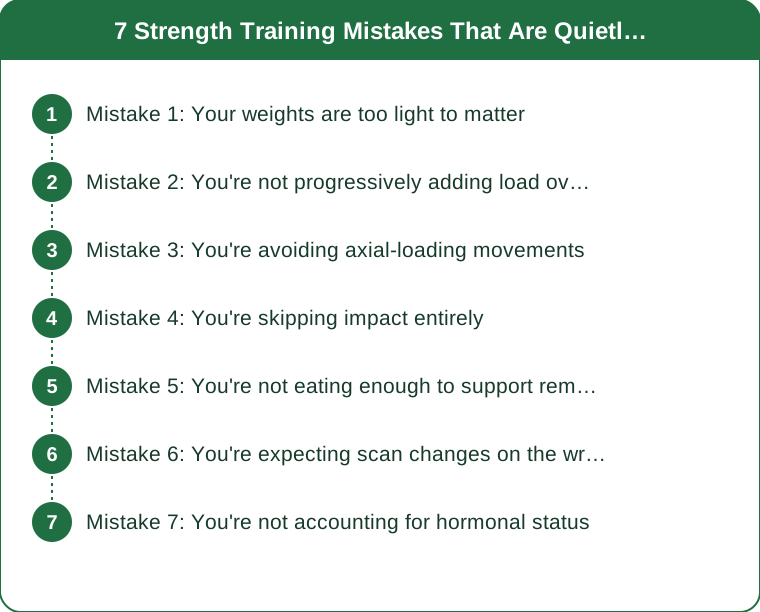
Mistake 1: Your weights are too light to matter
Bone responds to mechanical stress that exceeds what it experiences during normal daily movement — walking, standing, and light chores don’t provide enough stimulus to trigger new bone formation. Research on osteogenic loading generally points to working at 70-85% of your one-rep max for compound lifts to create the stress threshold bone actually responds to.
If you’ve been doing three sets of 15 with a weight you could lift 25 times, you’re almost certainly under that threshold. This is the single biggest reason committed lifters see muscle gains but flat bone scans — the load that builds muscle endurance isn’t automatically heavy enough to remodel bone. A rough gut check: your last 2 reps of a working set should feel genuinely difficult, not merely tiring.
This is worth sitting with, because it runs against the general fitness advice most women have absorbed for years: lift lighter, do more reps, protect your joints. That advice isn’t wrong for building endurance or general tone, but it’s specifically wrong for bone. The osteogenic threshold appears to work more like a light switch than a dimmer — below a certain intensity, the stimulus essentially doesn’t register with bone-forming cells at all, no matter how many total reps you accumulate. A practical way to test this: if you can’t name the last time a working set felt genuinely difficult on your last two reps, your loading almost certainly sits below that switch.
Mistake 2: You’re not progressively adding load over time
Bone remodeling requires a novel stimulus — lifting the same 20-pound dumbbells for a year gives your skeleton nothing new to adapt to after the first few months. Once a load stops feeling challenging, it stops driving further density gains, even if it still builds a good workout.
The fix is a structured progression: add roughly 2.5-5% to your working weight every 1-2 weeks on your main lifts (squat, deadlift, overhead press), tracked in a simple log. Most women plateau on bone-relevant loading around month 3-4 simply because they never wrote down what they lifted last time and unconsciously repeat it.
The tracking piece matters more than people expect. Memory is a poor substitute for a log, especially once a routine becomes automatic — most people who “progress by feel” actually plateau within a few months without realizing it, because the same weight that felt hard in January starts to feel routine by March, and routine is exactly what doesn’t drive further bone adaptation. A simple notes app entry (weight, reps, how the last 2 reps felt on a 1-10 scale) takes 15 seconds after a set and is often the single change that gets a stalled program moving again.
Mistake 3: You’re avoiding axial-loading movements
Bone responds most strongly to loading through the spine and hips — the sites where osteoporotic fracture risk is highest. Movements like squats, deadlifts, and overhead presses load the spine and hip axially; movements like leg extensions, bicep curls, and most machine-based exercises largely don’t.
A routine built mostly around machines and isolation work can look busy and still under-deliver for bone, because it skips the compound, axial-loading lifts that actually matter for hip and spine density. If your program doesn’t include a squat or deadlift variant and a loaded carry or overhead press, that’s a structural gap, not a minor detail.
This matters clinically as well as physiologically: hip fractures are the single most disabling osteoporotic fracture, and spine compression fractures are the most common, which is exactly why axial-loading movements deserve priority over isolation work rather than being an occasional add-on. A woman who does 45 minutes of leg press, leg extension, and bicep curls three times a week is training real muscle — but she’s largely skipping the two skeletal sites where density loss carries the highest real-world risk. Swapping even one machine exercise per session for a squat or deadlift variant closes much of that gap.

Mistake 4: You’re skipping impact entirely
Impact — not just resistance — provides a distinct bone-building stimulus through ground reaction force. Jump training, stair sprints, or even brisk hopping in place create forces on bone that slow, controlled lifting doesn’t replicate as effectively, particularly for hip bone density.
A small amount goes a long way: studies on jump-based interventions have used as few as 10-20 jumps, 3 times a week, done after a warm-up, to see measurable density benefits over 6-12 months. If your knees and joints tolerate it, adding a brief impact block to 2-3 sessions a week fills a gap that pure strength work leaves open. Anyone with joint pain, balance concerns, or a prior fracture should get individualized guidance before adding impact — this is a see-a-professional-first situation.
What makes impact training distinct from lifting is the rate of loading, not just the magnitude — ground reaction forces from a jump land on bone far faster than even a heavy, slow squat does, and bone cells appear to respond preferentially to that rapid loading rate. This is part of why former athletes who did jumping or court sports (basketball, volleyball) as teenagers often carry meaningfully higher bone density decades later, even after years away from the sport — the early impact exposure left a lasting mark. Starting later in life still helps, just more gradually and with more caution around joint readiness.
Mistake 5: You’re not eating enough to support remodeling
Bone remodeling is metabolically expensive, and training in a significant calorie deficit — common among women trying to also lose weight — can blunt the very adaptation you’re training for. Low energy availability is one of the most well-documented disruptors of bone density in active women, sometimes outweighing the benefit of the training itself.
Alongside adequate total calories, calcium (roughly 1,000-1,200mg daily) and protein (aim for 0.7-1g per pound of bodyweight) are the two nutrients most directly tied to whether mechanical loading actually converts into new bone. Under-fueling is an easy thing to overlook when the visible focus is the workout itself.
This creates a genuinely frustrating trap for a specific group of women: those simultaneously trying to build bone density and lose weight through a meaningful calorie deficit. The training signal (lift heavy, add impact) is telling the body to build; the nutrition signal (eat less) is telling it there aren’t enough resources to build with, and in low energy availability, bone-building processes are often deprioritized in favor of more immediately essential functions. A more sustainable approach for this group is a smaller, more moderate deficit paired with deliberately high protein and calcium intake, rather than an aggressive cut layered on top of serious strength training.
Mistake 6: You’re expecting scan changes on the wrong timeline
Bone remodeling is slow by design — a full remodeling cycle takes roughly 4-6 months, and DEXA scans are typically only meaningful 12-24 months apart because the year-to-year change is small enough that shorter intervals mostly capture measurement noise, not real change.
An eight-month scan showing “no change” may genuinely reflect a program that isn’t loading correctly — but it may also simply be too early to detect a real, in-progress gain. Pair your training log with your scan dates before concluding the program failed; if your loading checks out on points 1-4 above, an early scan is often the actual explanation, not a training failure.
This timeline mismatch is one of the most common sources of discouragement in bone-focused training, because it runs opposite to how muscle and cardiovascular fitness typically respond — those show up in weeks, while bone shows up in years. A useful mental model: think of a DEXA scan less like a monthly weigh-in and more like an annual eye exam — a slow-moving measure that isn’t designed to reflect short-term effort, even genuinely good effort. Scanning more frequently than every 12 months rarely provides useful information and can create false discouragement from noise alone.
Mistake 7: You’re not accounting for hormonal status
Estrogen plays a direct role in regulating bone remodeling, and the perimenopause-to-postmenopause transition can accelerate bone loss enough that strength training alone may only slow, not reverse, density decline during that window — which is a normal, expected pattern, not a sign your program is failing.
This doesn’t mean training doesn’t matter — it means expectations should account for hormonal stage. Women in this transition who see slower gains than a friend in her 30s aren’t doing something wrong; a doctor can help clarify whether medication or hormone therapy should be part of the broader plan alongside training. This is general information, not medical advice — bring your scan history to that conversation.
The practical takeaway isn’t to abandon training during this transition — it’s the opposite. Strength and impact training remain some of the few tools that meaningfully slow the rate of loss during a period when the body’s own hormonal support for bone maintenance is declining, even when they can’t fully reverse it on their own. Combining consistent, correctly-loaded training with a doctor’s guidance on hormonal or medication support tends to produce better outcomes than either approach alone — and knowing which mechanism (training gap versus hormonal stage) is driving a flat scan changes what the next conversation with a provider should focus on.
FAQ: Bone Density Training Questions, Answered
How heavy should I lift for bone density specifically?
Aim for 70-85% of your one-rep max on compound lifts, where your last 2 reps of a set feel genuinely hard. Light, high-rep training builds endurance but usually doesn’t hit the mechanical threshold bone needs.
Can walking alone improve bone density?
Walking supports general health and can modestly help, but it typically doesn’t provide enough mechanical stress to meaningfully build hip or spine density on its own — pairing it with progressive strength training and some impact work covers the gap.
How often should I get a DEXA scan to check progress?
Every 12-24 months is standard, since year-to-year changes are often too small for shorter intervals to detect reliably above normal measurement variation. Track your training load between scans instead of expecting monthly feedback.
TL;DR:
- Lift heavy enough that your last 2 reps feel genuinely hard (70-85% of 1RM) — light weights won’t trigger bone remodeling
- Progressively add load, prioritize axial-loading compound lifts, and consider a small amount of impact work
- Under-eating blunts bone gains as much as under-loading does — protein and calcium matter
- Give it 12-24 months between scans; 8 months often isn’t enough time to see real change
Audit your program against these 7 points before assuming your training isn’t working — for most women, at least one of these is the missing piece.
Keep Reading
This article is for general informational purposes only and is not medical advice. Always consult a qualified health professional for guidance specific to you.