How Long Weight Training Actually Takes to Improve Bone Density (A Realistic Timeline)
Quick Answer: Meaningful bone density improvement from weight training typically takes 8-12 months of consistent progressive strength training, measured through a follow-up bone density scan, though strength and balance improvements — which reduce fracture risk independently of bone density itself — show up much sooner, often within 6-8 weeks.
Bone density training gets marketed with the same before-and-after urgency as muscle-building content, but bone tissue simply doesn’t remodel on the same timeline as muscle. Understanding the real timeline prevents discouragement and helps set the right expectations from week one.

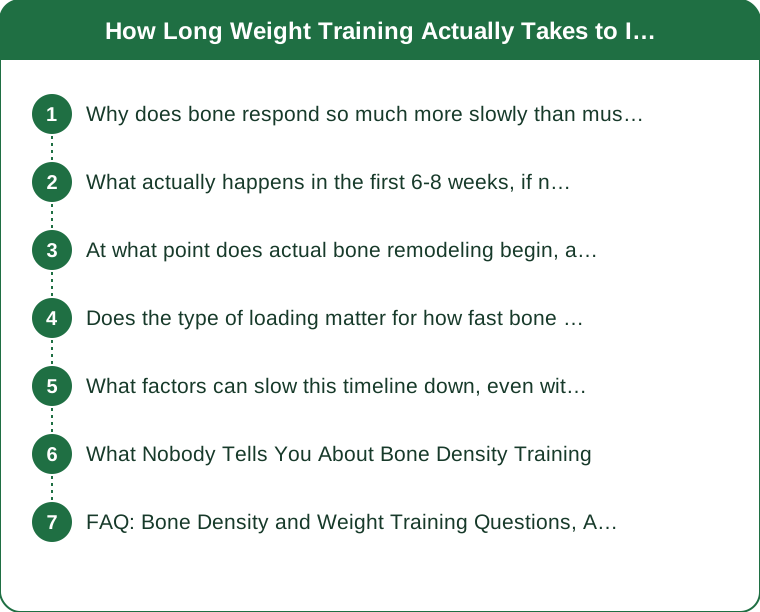
Why does bone respond so much more slowly than muscle to exercise?
Bone is living tissue, but its remodeling cycle — the process of old bone being broken down and new bone being built (through osteoclast and osteoblast activity) — operates on a months-long cycle, compared to the days-to-weeks cycle muscle protein synthesis operates on. This is a structural biological reality, not a sign that a training program isn’t working; it means bone density literally cannot show measurable change on the same timeline as visible muscle gains.
This mismatch is one of the most common reasons people abandon bone-focused strength programs early — they’re using muscle-building timelines to judge a process that runs on an entirely different clock.
What actually happens in the first 6-8 weeks, if not bone density change?
The earliest, most reliable changes are neuromuscular — your nervous system gets better at recruiting muscle fibers and coordinating movement patterns, which shows up as noticeably improved strength and stability well before any structural bone change occurs. This phase also improves balance and coordination, both of which reduce fall risk (and therefore fracture risk) independent of bone density itself.
This early phase is genuinely valuable and worth tracking separately from bone density — strength gains and balance improvements in the first two months are real signals the program is working, even though a bone scan wouldn’t show anything different yet.
At what point does actual bone remodeling begin, and how is it measured?
Research on osteogenic (bone-building) loading generally shows that meaningful bone mineral density changes require at least 6 months of consistent, progressively loaded training, with more robust results typically seen at the 8-12 month mark. This is measured through a DEXA (dual-energy X-ray absorptiometry) scan, the same test used for osteoporosis screening, comparing the same skeletal sites before and after a training period.
Most bone density research protocols use twice-weekly resistance training sessions targeting the hip and spine specifically, since those are the sites most clinically relevant for fracture risk and the ones DEXA scans typically measure.

Does the type of loading matter for how fast bone responds?
Yes, significantly. Bone responds best to loading that is progressive (gradually increasing weight over time) and involves impact or ground-reaction force (like squats, deadlifts, or weighted carries) rather than purely low-impact resistance work. Research consistently shows that novel, varied loading patterns stimulate more bone response than repeating the exact same movement pattern indefinitely, because bone adapts to the specific stress patterns it experiences and plateaus once a stimulus becomes routine.
This is part of why bone-focused programs typically rotate exercise variations every several weeks rather than running the identical routine for a full year.
What factors can slow this timeline down, even with consistent training?
Several factors independent of training consistency can slow bone response: inadequate protein or calcium intake, low vitamin D levels, hormonal factors (particularly post-menopausal estrogen decline), and certain medications. Someone training perfectly consistently but under-eating protein, for example, may see a slower bone response than someone with the same training consistency and adequate nutrition — which is why bone density programs typically address nutrition alongside training, not as an afterthought.
Sleep quality also plays a supporting role, since bone remodeling, like most tissue repair processes, happens more efficiently with adequate recovery.
What Nobody Tells You About Bone Density Training
Nobody mentions that the follow-up DEXA scan (usually done 1-2 years after starting, sometimes sooner) is itself an imperfect measurement — normal scan-to-scan variation exists even without any real change, meaning a small apparent decrease between scans doesn’t necessarily mean the training didn’t work. Providers typically look for changes larger than the expected measurement variation before calling a result meaningful, which most patients are never told, leading some to misread a statistically insignificant scan difference as a training failure.
FAQ: Bone Density and Weight Training Questions, Answered
How often should I get a bone density scan while training?
Most guidance suggests every 1-2 years for tracking change, since more frequent scanning won’t show meaningful new information given bone’s slow remodeling timeline.
Can bone density improve at any age, including after menopause?
Yes — research shows postmenopausal women can still achieve meaningful bone density improvements with consistent progressive strength training, though the timeline may run slightly longer than in younger populations.
Is walking enough for bone density, or is strength training necessary?
Walking provides some benefit but generally isn’t enough impact or load on its own for significant bone density improvement — progressive strength training with weights or resistance provides a stronger stimulus.
TL;DR:
- Bone remodels on a months-long cycle, unlike muscle, which responds in days to weeks
- Strength and balance improvements show up in 6-8 weeks, well before any bone density change
- Meaningful bone density change typically requires 6-12 months of consistent, progressive training
- Nutrition (protein, calcium, vitamin D) and sleep meaningfully affect how fast bone responds, independent of training consistency
Track strength and balance gains in the first two months as real, valid progress markers — don’t wait for a bone scan to know the program is working. This is general information, not medical advice.
Keep Reading
This article is for general informational purposes only and is not medical advice. Always consult a qualified health professional for guidance specific to you.