Rebuilding Bone Strength After a Fracture: A Realistic Month-by-Month Timeline
Quick Answer: Bone healing itself typically takes 6-12 weeks depending on the fracture site and your age, but rebuilding the surrounding muscle strength and bone density lost during immobilization takes considerably longer — often 4-6 months of progressive loading — and the two timelines are frequently confused, leading people to push too hard too soon or stay overly cautious long after they could safely progress.
Your doctor said the bone is healed. And yet lifting anything meaningful with that limb, or putting real weight through it, still feels shaky and weak weeks later. That gap between ‘healed’ and ‘strong again’ is real, predictable, and worth understanding on its own timeline.

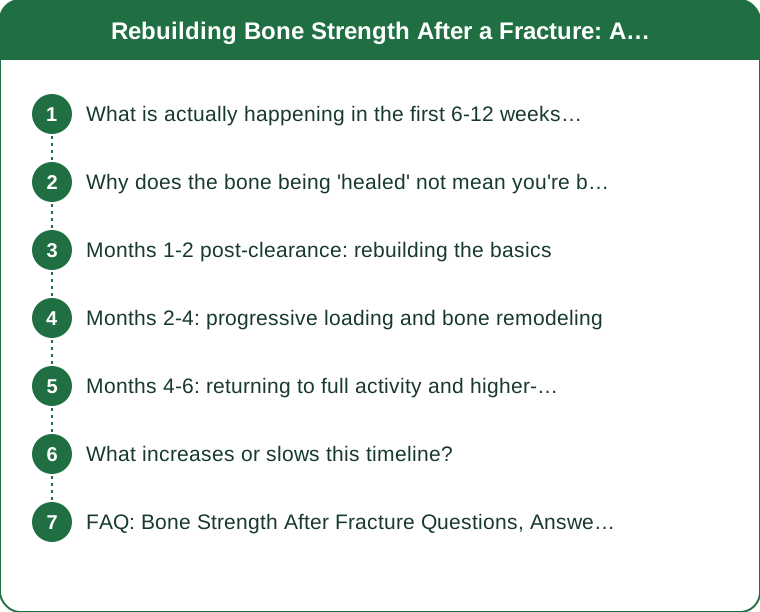
What is actually happening in the first 6-12 weeks after a fracture?
This is the primary bone-healing window, where your body forms a soft callus and then gradually mineralizes it into harder bone tissue. Timeline varies by bone — a wrist or finger fracture often heals faster than a hip or femur, and age is a meaningful factor, with healing generally slower past 50.
During this window, the surrounding muscles are also losing strength and mass from disuse, sometimes significantly, even while the bone itself is doing exactly what it should. This is normal, expected, and not a sign anything is going wrong — it’s simply the tradeoff of immobilization protecting the healing bone.
Movement during this phase should follow your provider’s specific guidance exactly, since premature loading of an unhealed fracture carries real risk. This is not a phase to self-direct.
Why does the bone being ‘healed’ not mean you’re back to normal?
Because imaging showing a healed fracture line answers a structural question, not a functional one. The muscles that support and move that bone have typically lost measurable strength during weeks of immobilization or reduced use, and bone density itself can dip locally during a prolonged unloaded period, even in bone tissue that wasn’t fractured.
This is the single most common source of frustration in fracture recovery: the imaging says done, but the body clearly isn’t functioning at its prior level yet. Both things are true simultaneously, and understanding that gap prevents the two most common mistakes — pushing too hard because ‘the doctor cleared me,’ or staying overly cautious for months longer than necessary out of fear.
Months 1-2 post-clearance: rebuilding the basics
Once cleared for movement, the priority is restoring range of motion and light-load strength before adding real resistance. Guided physical therapy is genuinely valuable here — a PT can assess exactly how much the surrounding musculature has weakened and build a progression specific to that, rather than a generic timeline.
Expect this phase to feel disproportionately hard relative to the light loads involved. A previously strong limb working with bodyweight or very light resistance can feel shockingly weak — this is a normal reflection of both muscle atrophy and reduced neuromuscular coordination after weeks of disuse, not a sign of a new problem.

Months 2-4: progressive loading and bone remodeling
This is where real strength and bone density rebuilding happens, through progressive, gradually increasing load — the mechanical stress from resistance training is one of the primary signals bone tissue uses to rebuild density (a principle known as Wolff’s Law).
Weight-bearing exercise, light resistance training, and gradually increasing load through the previously fractured area (within guidance from your provider or PT) drive this remodeling process. Progress here is typically steady but not linear — plateaus of a week or two where strength doesn’t seem to move are common and not usually a sign of a problem.
Months 4-6: returning to full activity and higher-impact movement
Higher-impact activity — running, jumping, heavier lifting — is generally the last piece reintroduced, and for good reason: impact tolerance in bone and connective tissue rebuilds more slowly than basic strength does. Many rehab protocols wait until strength and control benchmarks are met before adding real impact back in.
By this window, most people are functionally close to their prior baseline, though full bone density restoration at the fracture site can continue for up to a year or more in some cases, particularly in older adults or larger bones like the hip or femur. Functional strength returning well before bone density is fully restored is normal and doesn’t mean you need to remain overly cautious indefinitely — it means continuing sensible progressive loading rather than either avoiding activity or returning to full intensity all at once.
What increases or slows this timeline?
Age is one of the largest factors — healing and remodeling both generally take longer past 50, and considerably longer past 65-70. Nutrition matters throughout, particularly adequate protein, calcium, and vitamin D, which support both the initial healing and the longer remodeling phase.
Underlying bone density before the fracture also matters — someone with previously diagnosed osteopenia or osteoporosis typically needs closer monitoring and a more conservative progression than someone with normal baseline density. Smoking and poorly controlled diabetes are both well-documented factors that can meaningfully slow fracture healing and should be discussed directly with your care team if applicable.
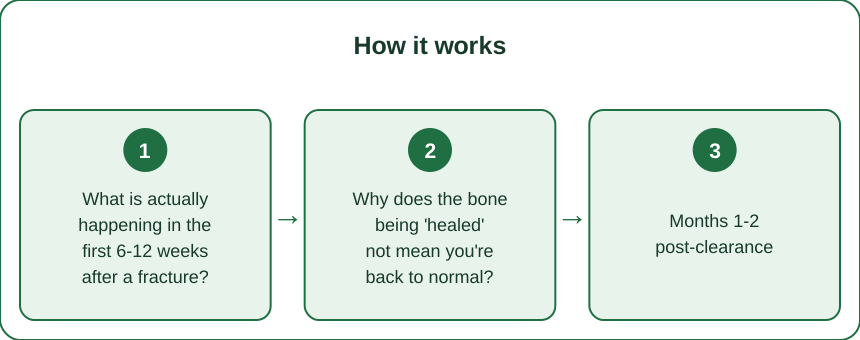
FAQ: Bone Strength After Fracture Questions, Answered
How long until a fracture site is as strong as before the injury?
Basic healing takes 6-12 weeks, but full functional strength and bone density restoration commonly takes 4-6 months, and sometimes up to a year for larger bones or older adults.
Is it normal to still feel weak months after being cleared?
Yes, especially in the first 1-2 months after clearance — muscle strength and neuromuscular coordination lag behind bone healing and require their own progressive rebuilding period.
Should I avoid all impact exercise until fully recovered?
Follow your provider’s specific timeline rather than a generic rule — most protocols reintroduce impact gradually in the later months, after strength and control benchmarks are met, not as an all-or-nothing decision.
Does a previous fracture make future fractures more likely?
A prior fracture can be a risk marker worth discussing with your doctor, particularly if it happened from a minor fall or impact, since it may prompt a bone density evaluation.
TL;DR:
- Bone healing (6-12 weeks) and full strength rebuilding (4-6 months, sometimes longer) are two different timelines, often confused
- ‘Healed’ on imaging doesn’t mean muscle strength or local bone density are back to baseline
- Progressive loading in months 2-4 is what actually drives bone remodeling, per Wolff’s Law
- Higher-impact activity is typically the last piece reintroduced, after strength and control benchmarks are met
- Age, nutrition, baseline bone density, and factors like smoking all affect the timeline
This is general information, not medical advice — follow your own provider or physical therapist’s specific timeline for your fracture and situation.
Keep Reading
This article is for general informational purposes only and is not medical advice. Always consult a qualified health professional for guidance specific to you.