The Complete Guide to Building Bone Density: What Actually Works
Quick Answer: Bone adapts to mechanical load that exceeds what it is used to - which means progressive resistance training and impact are the primary drivers, with adequate calcium, vitamin D and protein as the necessary supporting conditions. Walking alone is insufficient for building bone because it does not exceed habitual loading. The most effective programme combines heavy resistance work two to three times weekly with brief daily impact.
Bone is living tissue that remodels continuously throughout life, and what it remodels toward depends largely on what you ask of it. This is a long piece because the topic genuinely has several parts, and skipping any one of them is why most bone-health efforts underperform.

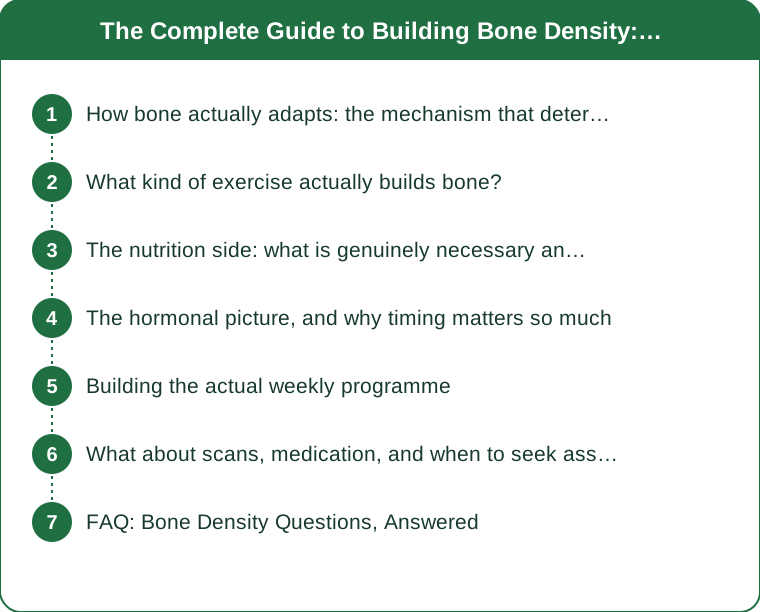
How bone actually adapts: the mechanism that determines everything else
Bone is not inert scaffolding. It is metabolically active tissue that is continuously broken down and rebuilt by two cell types working in opposition.
Osteoclasts break bone down. Osteoblasts build it back up. In a healthy adult these processes stay roughly balanced. When breakdown outpaces formation over years, density declines.
The governing principle is that bone adapts to the strain placed on it. Loading that exceeds what the tissue is accustomed to signals adaptation; loading it is already adapted to signals nothing.
This single principle explains most of what follows. It explains why walking, despite being genuinely excellent for cardiovascular health, does relatively little for bone density in someone who already walks daily - the load is habitual, so it carries no adaptive signal.
It explains why the rate of loading matters as much as the magnitude. Bone responds strongly to rapid, dynamic loading - a landing, a hop, a fast lift - and comparatively weakly to slow sustained load. Standing still is not a bone stimulus regardless of how long you do it.
It explains why bone adaptation is site-specific. Loading your legs builds bone in your legs. It does very little for your wrists. A programme that only trains the lower body leaves the upper body untouched, and wrist and forearm fractures are among the most common.
And it explains why the adaptation stops when the stimulus stops. Bone that was built through loading is maintained through continued loading. This is not a project with an end date, which is worth knowing at the start rather than discovering at year three.
The timeline is slow. Bone remodelling operates over months. Meaningful change in a density scan typically requires at least a year of consistent work, and expecting anything measurable at three months leads people to quit exactly when the process is beginning to work.
What kind of exercise actually builds bone?
Three categories do the work, and they do different jobs.
Progressive resistance training is the primary driver.
The key word is progressive. Load must increase over time or the stimulus disappears as you adapt. Lifting the same weight for a year builds bone for the first two months and maintains it thereafter.
The most effective exercises load the spine and hip directly - the two sites where fractures carry the greatest consequences. Squats, deadlifts, lunges, and overhead pressing all compress and load these areas through the skeleton in a way machine-based isolation work does not.
Intensity matters more than volume for bone. Research on bone adaptation consistently points toward heavier loads for lower repetitions being more effective than light loads for many repetitions. Something in the range of 5-8 repetitions at a genuinely challenging weight is a reasonable target for someone with training experience and no contraindications.
This is precisely where supervision matters. Heavy compound lifting is highly effective and requires competent technique. For anyone with existing low bone density, certain movements - particularly loaded spinal flexion - may be contraindicated, and that is a conversation for a doctor and a qualified trainer, not an article.
Impact and plyometric work is the second category.
Bone responds strongly to rapid loading. Brief, frequent impact appears to be more effective than long sessions - and importantly, the response saturates quickly. Roughly 10-20 hops or jumps produces most of the available signal; 200 does not produce ten times more.
A practical protocol: 10-20 hops or drop-landings, once or twice daily, on most days. It takes under a minute and it is genuinely one of the highest-return-per-time interventions available.
Progression for those not ready for jumping: heel drops - rise onto the toes and drop the heels firmly to the floor - provide impact loading with far less demand on the joints. Then small hops, then higher-impact work over months.
Balance and stability training is the third, and it addresses the other half of the problem.
Bone density determines how much force a bone can withstand. Balance determines whether that force ever arrives. Preventing falls matters at least as much as fracture resistance, particularly with age.
Single-leg standing, tandem walking, and any activity requiring dynamic balance all contribute. Tai chi has a reasonable evidence base for fall reduction specifically.
What does not build bone meaningfully: swimming and cycling, both excellent for other reasons, are non-weight-bearing and do little for bone density. Yoga and Pilates contribute modestly through bodyweight loading and considerably through balance, but neither approaches the effect of progressive resistance work.
The nutrition side: what is genuinely necessary and what is oversold
Nutrition does not build bone. It permits bone building that mechanical loading drives. That distinction determines how to think about the whole category.
Calcium is necessary and its role is widely misunderstood.
Calcium is the raw material. Without sufficient intake, the loading stimulus cannot be acted on, and the body maintains blood calcium levels by drawing on the skeleton.
General adult recommendations sit around 1,000mg daily, rising for postmenopausal women and older adults. Dietary sources are preferable to supplements for most people - dairy, fortified plant milks, tinned fish with bones, tofu set with calcium, leafy greens (though spinach’s calcium is poorly absorbed due to oxalates), and almonds.
More is not better. Very high supplemental intakes have not shown proportionally greater benefit and carry their own considerations. This is an area where meeting the target matters and exceeding it does not help.
Vitamin D is the gatekeeper.
Without adequate vitamin D, dietary calcium is poorly absorbed regardless of how much you consume. This is why the two are discussed together.
The primary source is sunlight on skin, which is why deficiency is common at higher latitudes and in winter. Late summer is actually the point in the year when stores are highest - which makes it the natural time to think about how you will maintain them through autumn and winter.
Dietary sources are limited: oily fish, egg yolks, and fortified foods. Many health authorities recommend supplementation during autumn and winter months, and a blood test is the only way to know your actual status. That is a conversation with a doctor.
Protein is the underappreciated one.
Roughly half of bone volume is protein - primarily collagen - and the mineral component is deposited onto that protein matrix. Inadequate protein intake limits bone formation independent of calcium status.
This matters particularly for older adults, who often eat less protein exactly when requirements rise, and for anyone in a calorie deficit.
Other contributors: vitamin K2, magnesium, and several trace minerals all participate in bone metabolism. A varied diet covers these. They are not the lever that a supplement industry sometimes suggests.
What actively works against bone: heavy alcohol consumption and smoking both have well-established negative effects on bone density. Very low body weight and inadequate overall energy intake are also significant risk factors, particularly relevant for athletes and anyone with a restrictive eating pattern.

The hormonal picture, and why timing matters so much
This is the part that is least controllable and most important to understand, because it determines how urgent the other parts are.
Peak bone mass is reached in the late twenties. Everything built before roughly age 30 is the foundation; everything after is maintenance and, at best, modest gain.
This is why bone health advice aimed at young women matters enormously and lands poorly - the payoff is decades away.
Oestrogen is strongly protective of bone, and its decline at menopause is associated with an accelerated period of bone loss, most rapid in the years immediately surrounding the transition.
This creates a specific window where intervention matters most: perimenopause and the years immediately following. Resistance training established before and maintained through this period is doing its most valuable work precisely then.
Amenorrhoea at any age is a significant bone risk factor. Absence of periods due to low energy availability, excessive training, or an eating disorder is associated with reduced bone density, and losses sustained during those years may not be fully recoverable. This is a medical issue, not a training one, and it warrants prompt attention.
Certain medications affect bone density, corticosteroids being the most commonly encountered. Anyone on long-term steroid treatment should be having a bone health conversation with their prescriber.
Family history matters. A parent with a hip fracture is a recognised risk factor, and it is worth knowing.
What to do with all this: these factors determine your baseline risk and therefore how aggressively to pursue the controllable elements. Someone with several risk factors has more to gain from a structured programme and more reason to have a formal assessment. This is general information, not medical advice - risk assessment and any decision about scanning or treatment belongs with a doctor.
Building the actual weekly programme
Here is what the evidence above assembles into, for someone with no contraindications who has been cleared to train.
Two to three resistance sessions weekly, each including:
- A squat pattern (goblet squat, back squat, or leg press progressing toward free weights)
- A hinge pattern (deadlift, Romanian deadlift, hip thrust)
- An overhead press - this is the upper body and spine loading that most programmes omit
- A row or pull, for the upper back and to balance the pressing
- A loaded carry - farmer’s walks load the spine, grip, and everything in between, and are among the most practical bone exercises available
Sets and repetitions: 3-4 sets of 5-8 repetitions at a weight that is genuinely challenging by the final repetition. Increase the weight when all sets are completed with clean form.
Daily impact work: 10-20 hops, jumps, or heel drops. Under a minute. Split into two brief sessions if convenient - the evidence suggests separated bouts may be more effective than one longer one.
Balance work, three times weekly: 60 seconds single-leg standing per side, progressing to eyes closed or an unstable surface. This can be done while the kettle boils.
Nutrition targets alongside it: calcium to the recommended level, mostly from food; vitamin D status checked and maintained; protein spread through the day rather than concentrated in one meal.
The realistic timeline: strength improves within weeks. Balance improves within weeks. Bone density changes over a year or more, and a scan repeated too soon shows nothing useful. Knowing this at the start is what makes people stay consistent long enough for it to work.
Where to start if the above is intimidating: the impact work and the balance work require no equipment, no gym, and under three minutes daily. Start there this week. Add the resistance training when you can arrange it properly, with instruction if you have not lifted before.
What about scans, medication, and when to seek assessment?
DEXA scanning is the standard measurement of bone mineral density, and results are typically reported as a T-score comparing you against a young adult reference.
Who is generally considered for scanning varies by country’s guidelines but commonly includes postmenopausal women with risk factors, anyone who has sustained a fracture from a minor fall, people on long-term corticosteroids, and those with conditions affecting bone metabolism. Your doctor determines this, not an article.
Repeat scanning too frequently is unhelpful - given how slowly bone changes, intervals of a year or more are typical, and the specific interval is a clinical decision.
Medication is a genuine option and is under-discussed in fitness contexts. Several classes of medication are established treatments for osteoporosis, and for someone with significantly reduced density, exercise and nutrition are complementary to treatment rather than a substitute for it. Framing lifestyle measures as an alternative to medically indicated treatment is a real harm that circulates widely in wellness content.
Signs that warrant a conversation with a doctor: a fracture from a fall from standing height or less, loss of height, a noticeable change in posture toward a forward curve, persistent unexplained back pain, or a family history of osteoporosis or hip fracture.
If you already have low bone density, exercise remains valuable and beneficial - but the programme needs professional design. Certain movements, particularly loaded forward bending and spinal twisting under load, may be contraindicated. A physiotherapist or an appropriately qualified trainer with experience in this area is the right person to build it.
This entire article is general information, not medical advice. It describes what the evidence broadly supports for bone health in general terms. Your own situation - your risk factors, your history, your current density - determines what is appropriate for you, and that assessment belongs with a doctor who can actually examine you.
FAQ: Bone Density Questions, Answered
Is it too late to build bone in my sixties or seventies?
No. Resistance training improves bone density and, critically, strength and balance at every age studied. The fall-prevention benefit alone is substantial, and it arrives far faster than density changes do.
How much does walking really do for bone?
For someone sedentary, starting to walk provides some benefit. For someone who already walks daily, it provides very little additional bone stimulus because the load is habitual. It remains excellent for cardiovascular and general health.
Do I need to lift heavy, or is bodyweight enough?
Bodyweight work is a legitimate starting point and better than nothing. But bone adapts to load exceeding what it is used to, and bodyweight is by definition what you carry all day. External load is what allows continued progression.
Are vibration plates effective?
Evidence is mixed and generally weaker than for resistance training and impact. Not a replacement for either.
How long before a scan would show a change?
At least a year, often longer. Bone remodelling is slow, and scanning sooner typically produces a result within measurement error rather than genuine information.
TL;DR:
- Bone adapts to load exceeding habitual levels - which is why walking alone does little for someone who already walks
- Progressive resistance training two to three times weekly is the primary driver; heavier loads for 5-8 reps beat light and high-rep
- 10-20 hops or heel drops daily captures most of the available impact benefit in under a minute
- Adaptation is site-specific - a legs-only programme leaves wrists and spine untouched
- Calcium, vitamin D and protein permit bone building; they do not drive it. Meet the targets, do not exceed them
- Balance training prevents the falls that density alone cannot
- Density changes take a year or more; strength and balance improve in weeks
This is general information, not medical advice. If you have risk factors, existing low density, or have fractured from a minor fall, the programme needs a professional’s input rather than an article’s.
Keep Reading
This article is for general informational purposes only and is not medical advice. Always consult a qualified health professional for guidance specific to you.