How Menopause Accelerates Bone Loss — and the Specific Steps That Actually Slow It Down
Quick Answer: Bone density loss accelerates dramatically during the menopause transition because declining estrogen directly reduces the body’s ability to rebuild bone as fast as it breaks it down — women can lose up to 20% of bone density in the 5-7 years around menopause, making this window the single most important time to intervene with weight-bearing exercise, protein, calcium, and vitamin D.
You’ve heard ‘bone density matters as you age’ for years, but the actual acceleration during menopause is faster and more specific than general aging advice usually explains — and understanding why changes what’s worth prioritizing right now.

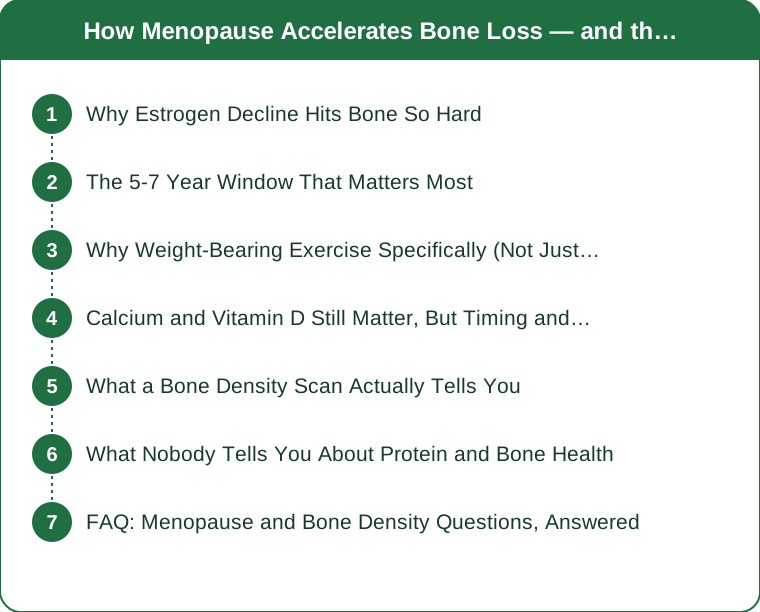
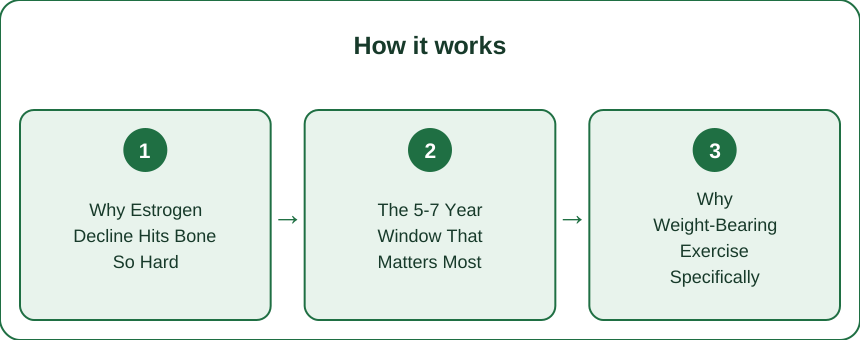
Why Estrogen Decline Hits Bone So Hard
Estrogen normally slows the activity of osteoclasts, the cells that break down old bone tissue, while supporting osteoblasts, the cells that build new bone. As estrogen drops during perimenopause and menopause, this balance shifts sharply toward breakdown outpacing rebuilding — a mechanism that’s different from the slower, more gradual bone loss associated with aging alone in men or younger women. This is why bone loss during the menopause transition isn’t just ‘aging faster,’ it’s a distinct hormonal mechanism with its own timeline, typically most rapid in the year before and several years after the final menstrual period.
The 5-7 Year Window That Matters Most
Research consistently shows the steepest bone density decline happens in a roughly 5-7 year window centered on the final menstrual period, with some women losing as much bone density in this window as they would otherwise lose over two full decades of normal aging. This makes early-to-mid perimenopause, not just post-menopause, an important time to start weight-bearing exercise and nutrition changes — waiting until a bone density scan flags a problem often means missing the window when intervention has the most leverage.
Why Weight-Bearing Exercise Specifically (Not Just Any Exercise)
Bone responds to mechanical loading — the actual physical stress of impact or resistance — by strengthening in the specific areas that experience that stress. Swimming and cycling, while excellent for cardiovascular health, don’t provide this loading signal to the hips and spine the way walking, jogging, stair climbing, or resistance training with weights does. For bone specifically, impact and resistance matter more than cardiovascular intensity. A combination of brisk walking most days plus two to three resistance training sessions per week targeting the hips, spine, and wrists (common fracture sites) gives the most comprehensive stimulus.

Calcium and Vitamin D Still Matter, But Timing and Form Matter Too
The commonly cited target of 1,200mg of calcium daily during and after menopause is easier to hit through food (dairy, fortified plant milks, leafy greens, canned fish with bones) than most people assume, and food sources are generally absorbed better than large single supplement doses. Vitamin D, which enables calcium absorption in the first place, is frequently deficient in adults regardless of diet, since sun exposure and dietary sources alone often aren’t sufficient — a blood test can confirm whether supplementation at a specific dose is warranted.
What a Bone Density Scan Actually Tells You
A DEXA scan produces a T-score comparing your bone density to a healthy young adult, with scores between -1.0 and -2.5 indicating osteopenia (lower-than-ideal but not yet osteoporosis) and scores below -2.5 indicating osteoporosis. Most guidelines recommend a baseline scan around age 65, or earlier if risk factors like early menopause, a family history of osteoporosis, or long-term steroid use are present — getting a baseline scan during perimenopause, even before it’s officially recommended, gives you a comparison point for tracking change over the following years.
What Nobody Tells You About Protein and Bone Health
Bone tissue is roughly half protein by volume, not just calcium and minerals, and inadequate protein intake during the menopause transition can undermine bone rebuilding even when calcium and vitamin D intake are adequate. Many women unintentionally reduce protein intake during this life stage while focusing heavily on calcium alone — aiming for protein at every meal, not just at dinner, supports both bone maintenance and the muscle mass that protects against fall-related fractures.
FAQ: Menopause and Bone Density Questions, Answered
Is hormone replacement therapy an option for protecting bone density?
HRT can help preserve bone density for some women and is a conversation worth having with a doctor who can weigh personal risk factors and benefits — this is general information, not medical advice, and the decision should be individualized.
Can bone density loss during menopause be reversed once it happens?
Some bone density can be regained with consistent weight-bearing exercise, adequate protein, calcium, and vitamin D, though full reversal to pre-menopause density isn’t guaranteed — the more realistic goal is slowing loss and building strength around the bones you have.
How often should bone density be re-scanned during menopause?
Most guidelines suggest every 1-2 years once a baseline is established, though your doctor may recommend a different interval based on your specific risk factors and initial results.
TL;DR:
- Estrogen decline shifts the bone-breakdown/bone-building balance sharply during menopause
- The 5-7 years around the final menstrual period is the steepest decline window
- Weight-bearing and resistance exercise provide mechanical loading that cardio alone doesn’t
- Protein intake matters for bone health as much as calcium and vitamin D
This is general information, not medical advice — a doctor or endocrinologist can help build a plan specific to your risk factors and bone density scan results.
Keep Reading
This article is for general informational purposes only and is not medical advice. Always consult a qualified health professional for guidance specific to you.