How to Build Bone When Your Joints Cannot Take Impact
Quick Answer: Bone responds to strain magnitude and strain rate, and heavy resistance training provides both without any impact at all. If jumping is off the table, build around progressively heavy squats, deadlifts or hip hinges, loaded carries, overhead pressing, and rowing, done 2 to 3 times a week at loads you could only lift 6 to 10 times. Add low-level impact later, only if and when your joints allow.
Almost every article on bone density arrives at the same instruction within four paragraphs: jump. Hop, skip, drop from a step, do plyometrics. It is good advice and it is completely unusable if you have a knee replacement, an irritable hip, a history of stress fractures, or an existing spinal issue - which describes a very large share of the people who are being told to worry about bone in the first place.
This is the version for them. It is longer than the usual advice because the answer is genuinely more detailed, and because getting it wrong wastes years.

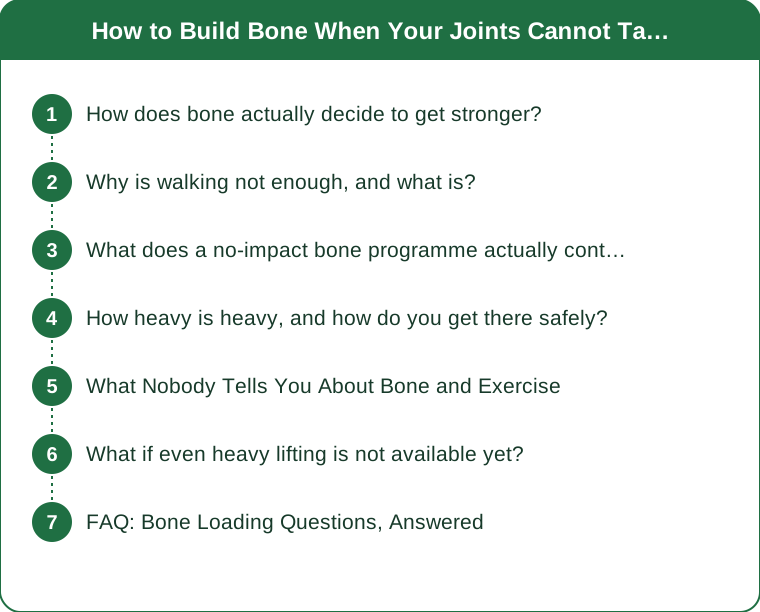
How does bone actually decide to get stronger?
Bone is living tissue in constant turnover. Osteoclasts break down old bone, osteoblasts build new bone, and the balance between the two determines whether density rises or falls. That balance responds to mechanical signals, and the signals it listens to are specific.
The governing idea is usually described as the mechanostat: bone adapts to keep the strain it experiences within a preferred range. If habitual strain rises above that range, bone builds. If it falls below, bone is resorbed as an unnecessary metabolic expense. This is why bed rest and spaceflight cause rapid bone loss - not because anything is wrong, but because the tissue is correctly responding to an absence of demand.
Three properties of a load matter:
Magnitude. How much strain the load produces. Higher is more effective, and this is the single most important variable. Light loads do essentially nothing for bone regardless of how many repetitions you do.
Rate. How quickly the strain is applied. Fast loading is a stronger signal than slow loading at the same magnitude, which is precisely why impact works so well - a landing applies large strain in milliseconds.
Novelty and distribution. Bone habituates. A load pattern it experiences constantly produces a diminishing response, and unusual directions of loading produce a stronger one. This is why walking - which your skeleton has experienced daily for decades - does very little, and why the same amount of mechanical work in a new pattern does more.
Crucially, magnitude and rate can both be delivered by heavy lifting. A heavy squat produces substantial strain through the hip and spine. Accelerating out of the bottom of that squat produces it quickly. You do not need to leave the floor to give bone something to respond to.
Why is walking not enough, and what is?
Walking is excellent for cardiovascular health, mood, blood sugar, and joint nutrition. As a bone stimulus in someone who already walks, it is close to useless, and the research on walking-only interventions for bone density has been consistently underwhelming.
The reason is habituation plus magnitude. The ground reaction force of walking is roughly one to one and a half times bodyweight, applied slowly, in a pattern your skeleton has seen every day of your adult life. It sits comfortably inside the range the mechanostat considers normal, so there is nothing to respond to.
What has actually shown benefit in trials of postmenopausal women - the group most studied - is progressive high-intensity resistance training, often combined with impact. The most cited example is the LIFTMOR trial, which used heavy deadlifts, overhead press, and back squats at loads around 80 to 85 percent of one-rep max, twice a week for eight months, in postmenopausal women with low bone mass. It produced measurable increases in lumbar spine and femoral neck bone mineral density, in a supervised setting, with a low rate of adverse events.
The key word is heavy. Trials using light weights and high repetitions generally fail to move bone density even when participants get noticeably fitter and stronger in an everyday sense. Muscle adapts to a wide range of loading; bone is fussier and only really listens above a threshold.
This is genuinely good news for anyone who cannot jump. It means the most evidence-backed intervention available is one where your feet never leave the ground.
What does a no-impact bone programme actually contain?
Five movement categories cover the sites that matter most - hip, spine, and wrist.
1. A loaded squat pattern. Back squat, front squat, or goblet squat depending on what your joints and equipment allow. Loads the spine axially and the hip through range.
2. A hip hinge. Deadlift, trap bar deadlift, Romanian deadlift, or a hip thrust if spinal loading is contraindicated. The trap bar version is often the most joint-friendly entry point and allows the heaviest loads soonest.
3. Overhead pressing. Loads the spine from above and puts strain through the upper limb and shoulder girdle.
4. Loaded carries. Farmer’s carries and suitcase carries. Underrated for bone because they load the spine, hip, and wrist simultaneously and are extremely hard to do with bad technique.
5. Rowing and pulling. Bent-over rows and pulldowns for the upper back, which matters for posture and for vertebral loading.
A workable weekly structure is two to three sessions, 45 to 60 minutes, on non-consecutive days. Each session includes a squat pattern, a hinge, a press, a pull, and a carry, at 3 to 5 sets of 5 to 8 repetitions once you are established.
The wrist deserves a specific mention, because distal radius fractures are among the most common osteoporotic fractures and almost nothing in a standard programme loads the wrist. Carries help. So does a front rack hold and, later, pushing work on the hands if your wrists tolerate it.

How heavy is heavy, and how do you get there safely?
This is where people either stall for years or get hurt in month two, and the difference is entirely about the ramp.
Months 1 to 2: technique at trivial loads. Learn the patterns with an empty bar, a light kettlebell, or bodyweight. The goal is not stimulus, it is that the movement is repeatable when it gets heavy. If you can afford a handful of sessions with a coach, this is where they pay for themselves.
Months 2 to 4: build tolerance. 3 sets of 8 to 10 at a weight you could have done 4 or 5 more repetitions with. This period builds the tendon, ligament, and connective tissue capacity that lets you handle heavy loading later. Skipping it is the single most common cause of injury in people starting resistance training for bone.
Months 4 onward: progressive loading. Work toward 3 to 5 sets of 5 to 8 repetitions at a load you could only lift 6 to 10 times - hard, but with technique intact and no grinding. Add small increments, weekly if possible.
The intensity guide that works without testing a one-rep max: finish each set feeling you had 1 to 3 repetitions left. That corresponds roughly to the intensity range used in the successful trials, without ever needing to attempt a maximal lift.
Progression should be slow and boring. An extra 2.5kg on a lift every week or two is 60 to 130kg of added load over a year, which is an enormous change from a starting point of nothing. Nobody needs to rush this, and the people who do are the ones who end up sitting out for three months with an irritated back.
What Nobody Tells You About Bone and Exercise
Bone changes slowly and DEXA scans are noisy. Meaningful density change takes 12 months or more to appear on a scan, and short-term rescanning mostly measures measurement error. If you started training four months ago and the scan looks unchanged, that is expected, not failure.
Muscle mass matters independently. Larger muscles pull harder on bone, and stronger people fall less. A significant share of fracture prevention comes from not falling in the first place, which makes balance training as valuable as loading - and it is completely impact-free. Single-leg stands, tandem walking, and step-ups all count.
Site specificity is real. Loading the hip does not build the wrist. If your scan shows a specific weak site, the programme should include something that loads that site directly.
Protein and vitamin D are permissive, not optional. Loading with inadequate protein or vitamin D is like training with the door locked. Most guidance lands around 1.0 to 1.2g of protein per kg bodyweight per day for older adults, with adequate calcium and vitamin D - but the specifics depend on your bloodwork and medications, which is a conversation for your doctor.
And some of this is not modifiable by exercise alone. If you have established osteoporosis, exercise is an adjunct to medical management, not a replacement for it. People with high fracture risk sometimes get better results from medication plus training than either alone. Discuss it rather than deciding it yourself.
What if even heavy lifting is not available yet?
There is a real version of this question. Some people arrive at bone health with a recent fracture, significant osteoporosis, severe arthritis, or a spinal condition that rules out axial loading for now.
Start with what is available and build capacity toward loading rather than abandoning it.
- Machine-based resistance removes balance and technique demands and lets you load progressively with much lower risk. Leg press, chest press, seated row, and lat pulldown are all viable, and a leg press can be loaded very heavily very safely.
- Isometrics - pushing hard against an immovable resistance - produce high strain with no movement and no joint travel. Useful when range of motion is the limitation.
- Blood flow restriction training with light loads is an option some physiotherapists use where heavy loading is contraindicated, and it has evidence for muscle adaptation. Its direct effect on bone is less established, so treat it as a bridge rather than a destination.
- Balance and fall prevention work, every single day, regardless of everything else. If your fracture risk is high, the intervention with the fastest payoff is not falling.
- Aquatic exercise is genuinely good for pain, function, and confidence, and genuinely poor for bone, because buoyancy removes the load. Do it for the other reasons, and do something loaded on land as well.
With spinal osteoporosis specifically, forward bending under load and heavy spinal flexion are commonly advised against because of vertebral compression fracture risk. That rules out some exercises and not the whole category. This is exactly the situation where a physiotherapist with an interest in bone health earns their fee - the programme is buildable, it just needs to be built around your specific restrictions rather than a generic list.
This is general information, not medical advice. If you have diagnosed osteopenia or osteoporosis, a fracture history, or any spinal condition, get a programme cleared by a doctor or physiotherapist before you start loading.
FAQ: Bone Loading Questions, Answered
Can you increase bone density without impact exercise?
Yes. Progressive heavy resistance training provides both high strain magnitude and reasonable strain rate, and it is the intervention with the strongest supporting trial evidence in postmenopausal women. Impact adds to it but is not the only route.
How heavy do weights need to be for bone health?
Heavy enough that you could only manage roughly 6 to 10 repetitions, finishing each set with 1 to 3 in reserve. Light weights and high repetitions build endurance and generally do not shift bone density.
How long before bone density improves?
Expect 8 to 12 months before changes are measurable on a DEXA scan, and treat anything shorter as too soon to judge. Strength itself improves within weeks, which is the more useful short-term feedback.
Is walking useless for bone?
Not useless for health overall, but close to useless as a bone stimulus in someone who already walks regularly. Bone habituates to familiar low-magnitude loading. Keep walking, and add loading separately.
TL;DR:
- Bone responds to strain magnitude and strain rate - heavy lifting delivers both with zero impact.
- Build around a squat, a hinge, an overhead press, a pull, and carries, twice or three times weekly.
- Ramp over months: technique, then tolerance, then genuinely heavy work at 6 to 10 rep loads.
- Expect 8 to 12 months before a scan shows anything; balance training pays off far faster.
- If heavy loading is off the table, machines, isometrics, and daily balance work are the bridge, not the destination.
The advice to jump is not wrong - it is just incomplete, and it quietly excludes the people who most need a plan. Loading is the mechanism. Impact is only one way to deliver it, and the other way is available to almost everyone.
Keep Reading
This article is for general informational purposes only and is not medical advice. Always consult a qualified health professional for guidance specific to you.