What Actually Counts as Bone Loading: A Complete Guide to Impact, Load, and Direction
Quick Answer: Bone responds to forces that are high in magnitude, applied rapidly, and unusual in direction - and it stops responding to any force it’s already used to. That’s why walking, however much you do, adds little for someone who already walks: the load is familiar and low. Heavy resistance training, impact, and multidirectional movement are the three categories that matter, and 10 minutes of the right thing beats an hour of the wrong thing.
Half of bone health advice is ‘do weight-bearing exercise’. Almost none of it explains which weight, how much bearing, or why your daily walk isn’t doing what you assumed.

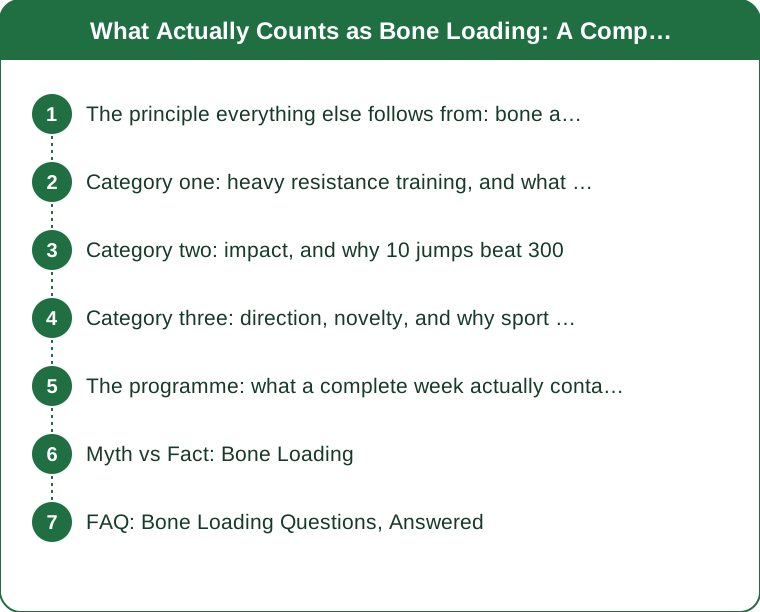
The principle everything else follows from: bone adapts to unusual load
Bone is living tissue that continuously remodels itself in response to the mechanical demands placed on it. This has been the organising principle of bone biology since the nineteenth century, when it was observed that the internal architecture of bone aligns with the lines of stress it experiences.
The critical implication is that bone adapts to what’s unusual, not to what’s typical. Your skeleton has already fully adapted to the loads of your ordinary life - walking, standing, carrying shopping, climbing your stairs. Doing more of those things provides essentially the same signal it has been receiving for years, and a signal that’s already been adapted to produces no further adaptation.
This explains a finding that confuses a lot of people: walking programmes produce very modest bone density changes in already-ambulatory adults. Walking is genuinely excellent for cardiovascular health, mood, joint health, and general function, and it should not be discouraged. But as a bone-building stimulus for someone who already walks, it’s close to neutral, because it is precisely the load your skeleton is already built for.
Three characteristics determine whether a load actually signals bone to adapt:
Magnitude. The force has to be meaningfully higher than habitual. This is why heavy resistance training works and light weights largely don’t - the load has to exceed what your skeleton already handles.
Rate. How fast the force is applied matters independently of how large it is. Rapidly applied forces produce a stronger signal than the same force applied slowly, which is the mechanism behind impact activities like jumping and hopping.
Direction and novelty. Bone responds strongly to forces applied in unfamiliar directions. A skeleton adapted to vertical loading from walking gets a substantial signal from lateral, rotational, or diagonal loading - which is why multidirectional activities punch above their weight.
And a fourth characteristic that runs the other way: saturation. The bone-building response saturates quickly within a single session. The first handful of loading cycles provides most of the signal, and the hundredth provides very little. This is why 10 well-chosen jumps produce a comparable signal to several hundred, and why frequency across the week matters more than volume within a session.
Everything practical in this guide follows from those four facts. This is general information, not medical advice.
Category one: heavy resistance training, and what ‘heavy’ actually means
This is the most evidence-supported category and the one most often watered down in practice.
The muscles that attach to a bone pull on it, and that pull is one of the largest forces that bone experiences. Muscle contraction generates loads on the skeleton that can exceed the forces from bodyweight impact. This is why resistance training works even for exercises that aren’t obviously ‘weight-bearing’ in the everyday sense.
The load has to be genuinely heavy. The trials that produce meaningful bone density changes generally use loads in the range of 80-85% of a one-repetition maximum - which in practice means sets of about 5-8 repetitions where the last rep is genuinely difficult. Programmes using light weights for high repetitions consistently fail to produce comparable bone outcomes, even when they improve muscle endurance and function considerably.
This is the single biggest gap between general advice and effective practice. ‘Strength training for bone health’ is frequently interpreted as 2kg dumbbells and 15 repetitions, which builds confidence and coordination but provides a loading signal well below the threshold bone responds to.
The exercises that matter most are compound, axial, and load the hip and spine:
- Squats and their variations - load the spine and hip directly through the line of the skeleton
- Deadlifts and hip hinges - among the highest-load exercises available for the hip and lumbar spine
- Overhead press - loads the spine axially and the upper limb
- Loaded step-ups and split squats - unilateral hip loading with a balance component
- Loaded carries - sustained axial spinal loading with a rotational stability demand
Frequency and progression: two to three sessions a week, with the load progressing over time. The progression is the intervention. A programme that uses the same weight for a year provides a stimulus that stops being unusual after the first few months.
An important safety note: for people with established osteoporosis or vertebral fractures, loaded spinal flexion - deep forward bending under load, and loaded sit-up-style movements - carries genuine fracture risk and is generally advised against. Supervised, progressive high-intensity training has been studied in postmenopausal women with low bone mass with encouraging results, but that supervision is part of the finding. If you have a diagnosis, this is a conversation with a clinician and an experienced coach, not something to self-prescribe from an article.
Category two: impact, and why 10 jumps beat 300
Impact loading produces the high strain rates that bone responds to particularly strongly, and it’s the most time-efficient category by a wide margin.
Ground reaction forces during jumping and hopping can reach several times bodyweight, applied over a fraction of a second. That combination of magnitude and rate is close to the ideal osteogenic signal, and it explains why athletes in jumping and impact sports consistently show higher bone density than endurance athletes in non-impact sports - and why swimmers and cyclists, despite excellent fitness, often show unremarkable bone density.
The saturation effect makes this efficient. Because the response saturates within a session, effective jumping protocols are remarkably short. Trials using approximately 10-50 jumps performed a few days a week have produced measurable hip bone density benefits in premenopausal women. That’s a two-minute intervention.
What this looks like in practice:
- Multidirectional hops - forward, backward, side to side, and diagonally, 10 in each direction
- Jumps with a controlled landing - the landing is where the force is highest
- Skipping or rope jumping - accessible, and easy to do in short bouts
- Heel drops - rising onto the toes and dropping the heels sharply, useful for people not ready for full jumping
- Stair descent - loads the hip meaningfully and is easy to accumulate
The critical detail is rest between bouts. Because the signal saturates, splitting jumps into short bouts spread across the day produces a stronger cumulative signal than doing them all at once. Ten jumps in the morning and ten in the afternoon is better than twenty in a row.
Who this isn’t for, at least not initially: anyone with existing fragility fractures, significant osteoporosis, severe joint disease, or balance impairment sufficient to make jumping a fall risk. The fracture risk of a fall outweighs the bone benefit of the jump for people in those groups, and the appropriate progression starts with heel drops, stair descent, and supervised load rather than jumping. Again - a clinician’s call, not an article’s.

Category three: direction, novelty, and why sport beats the gym for this one thing
The third characteristic - unusual direction - is the least discussed and arguably the most interesting.
Bone adapted to one loading direction is not adapted to another. A skeleton loaded exclusively vertically, through walking, running, and standing, develops in response to vertical strain. Introduce a lateral or rotational force and it’s genuinely novel, which produces a disproportionate adaptive response for the force involved.
This is the mechanistic explanation behind a striking observation: racquet sport players show substantially greater bone density in the playing arm than the non-playing arm - differences of a magnitude that no supplement or medication produces, in the same person, from the same genetics and diet. The difference is entirely mechanical loading, and it’s the cleanest natural demonstration of the principle available.
Activities that provide directional novelty:
- Racquet sports - tennis, squash, badminton, padel. High-rate, multidirectional, with rotational loading through the spine and hip
- Dance - particularly forms with jumps, turns, and rapid direction change
- Court and field sports - basketball, netball, football, with their cutting and pivoting
- Multidirectional agility drills - lateral shuffles, carioca, cutting patterns
- Loaded carries with asymmetric load - a single-sided suitcase carry loads the spine in lateral flexion resistance, which is a direction almost nothing else in a gym provides
Why this matters for programme design: a person doing squats, deadlifts, and jumping is covering magnitude and rate but loading almost entirely in the sagittal plane, vertically. Adding one weekly activity with genuine multidirectional demand covers a gap that adding more weight to the squat cannot.
The practical recommendation: one session a week of something that moves you sideways and rotationally. A racquet sport is the highest-value option because it combines all three characteristics at once - and it’s also the one people actually keep doing for decades, which matters more than any acute stimulus.
The programme: what a complete week actually contains
Combining the three categories into something a person with a job can maintain.
The weekly template:
Two heavy resistance sessions. 45 minutes each. Squat or leg press, a hip hinge, an overhead press, a row, and a loaded carry. Working sets of 5-8 repetitions at a genuinely challenging load, progressing over months. This is the backbone of the programme and the part most worth getting supervised initially.
Impact work, four to five days a week, two minutes each. 10-20 multidirectional hops or jumps, ideally split into two short bouts. This can be attached to anything - after brushing your teeth, before a shower, at the kettle. The habit-stacking approach works far better than scheduling it as its own event.
One multidirectional session. A racquet sport, a dance class, or 20 minutes of agility work. This is the enjoyment slot as much as the loading slot, and picking something you’ll still be doing in five years matters more than optimising it.
Balance and fall-prevention work, most days. This isn’t bone loading, and it belongs in the programme anyway. The great majority of fragility fractures happen because of falls, which means fall risk and bone density are two separate levers on the same outcome. Single-leg stance while brushing your teeth costs nothing.
Walking, as much as you like. For cardiovascular and metabolic health, mood, and joint health - all genuinely valuable. Just don’t count it toward the bone column.
The nutritional inputs that gate all of this: adequate calcium, adequate vitamin D, and adequate protein and total energy. Bone is built from materials, and training without sufficient intake produces a poor return - notably, low energy availability is associated with impaired bone health regardless of how well-designed the training is. Blood levels and supplementation decisions belong with your doctor.
Realistic expectations on timeline: bone remodels slowly. Meaningful bone density change takes 6-12 months minimum to be measurable, and DXA scans are typically repeated no more frequently than every one to two years for this reason. Strength and balance improvements arrive in weeks; the bone changes are running underneath on a much longer clock.
Myth vs Fact: Bone Loading
Myth: Walking is enough to maintain bone density. Fact: For already-ambulatory adults, walking provides a habitual, low-magnitude load that bone has already adapted to, and walking programmes produce only modest bone density effects. It’s excellent exercise for other reasons and shouldn’t be dropped - it just isn’t doing the bone job people assume.
Myth: Light weights with high repetitions build bone. Fact: The magnitude threshold is real. Trials producing bone density benefits typically use loads around 80-85% of maximum for low repetitions. Light-weight, high-repetition training improves muscular endurance and function without providing the loading signal bone responds to.
Myth: Swimming and cycling are good for bones because they’re exercise. Fact: Both are outstanding for cardiovascular health, and both are non-weight-bearing. Cyclists and swimmers frequently show unremarkable or below-average bone density despite excellent overall fitness - a well-documented finding that surprises people every time.
Myth: If you have osteoporosis you shouldn’t lift heavy. Fact: Progressive, supervised high-intensity resistance training has been studied in postmenopausal women with low bone mass with promising results. The nuance is real though - specific movements, particularly loaded spinal flexion, carry genuine risk, and supervision is part of what makes the approach safe. This is a clinician conversation.
Myth: More jumping is better. Fact: The response saturates within a session. Ten to fifty jumps a few days a week captures most of the available benefit, and hundreds of jumps mostly add joint stress and soreness without adding signal.
Myth: Calcium supplements build bone on their own. Fact: Adequate calcium is necessary and not sufficient. Without a mechanical loading signal telling bone to remodel, the raw material has nothing driving it into use. Nutrition permits the adaptation; loading causes it.
Myth: It’s too late to start after menopause. Fact: Bone continues responding to mechanical loading throughout life. The rate of gain is lower than in youth, and the value of slowing loss and improving strength, balance, and fall risk is substantial at every age.
FAQ: Bone Loading Questions, Answered
How heavy is heavy enough?
A weight you could lift roughly 5-8 times before form breaks down, with the last repetition genuinely difficult. If you could do 15, it’s below the threshold that produces bone adaptation.
Can I build bone with bodyweight exercise alone?
Partly - jumping and impact work is bodyweight-based and genuinely effective. The heavy resistance component is much harder to replicate without external load once you’re reasonably strong.
How long before a scan shows a change?
Bone remodels slowly. Expect 6-12 months minimum for measurable change, which is why DXA scans are typically repeated at one to two year intervals rather than more often.
Is it safe to jump if I already have low bone density?
That depends on your diagnosis and fracture history, and it’s a question for your clinician. Heel drops, stair descent, and supervised progressive resistance training are usually the appropriate starting point rather than jumping.
Does the exercise have to be uncomfortable to work?
Heavy resistance training should feel genuinely effortful in the last repetitions. It should not be painful, and joint pain during loading is a signal to adjust the movement rather than push through it.
TL;DR:
- Bone adapts to unusual load - magnitude, rate, and direction - and ignores what it’s used to
- Heavy resistance training at 5-8 hard reps is the backbone; light weights don’t reach the threshold
- Impact saturates fast: 10-50 jumps a few days a week, split into short bouts, is the whole dose
- Add one multidirectional activity weekly; racquet sports cover all three characteristics at once
- Walking is excellent exercise and close to neutral for bone in people who already walk
- Expect 6-12 months before anything shows on a scan, and get a clinician involved if you have a diagnosis
The question isn’t whether you’re exercising. It’s whether the force is bigger, faster, or stranger than what your skeleton already expects.
Keep Reading
This article is for general informational purposes only and is not medical advice. Always consult a qualified health professional for guidance specific to you.